Argon vs Krypton Gas in Windows: Performance & Cost Comparison
Noble gas fills between window panes improve insulation — but should you choose argon or krypton? Here is a detailed performance and cost comparison with recommendations for DMV homes.
Mike Reynolds
Lead Glass Technician & Owner
In This Article
How Noble Gas Fills Improve Window Performance
The space between the glass panes in an insulated glass unit (IGU) plays a critical role in the window's thermal performance. Air — which is approximately 78 percent nitrogen and 21 percent oxygen — provides some insulation in this cavity, but its molecules are relatively small and energetic, readily transferring heat through convection (circulating currents within the cavity) and conduction (molecule-to-molecule heat transfer). Replacing the air with a heavier, less conductive noble gas significantly reduces both convection and conduction within the cavity.
Argon and krypton are the two noble gases used commercially in insulated glass. Both are naturally occurring, non-toxic, odorless, colorless, and chemically inert — they do not react with the glass, the spacer materials, or the sealant. Their thermal performance advantage comes from their higher molecular weight and lower thermal conductivity compared to air. Argon has a thermal conductivity roughly 67 percent that of air, while krypton's thermal conductivity is only about 36 percent that of air. This translates directly into lower U-factors (better insulation) for the finished window.
In the DMV area, where winters bring sustained cold (average January lows in the mid-20s Fahrenheit) and summers bring extreme heat and humidity (average July highs in the upper 80s to low 90s), every improvement in window insulation has a measurable impact on energy costs and comfort. Gas-filled IGUs reduce heat loss in winter and heat gain in summer, benefiting both heating and cooling performance. The question for DMV homeowners is not whether gas fills are worthwhile — they clearly are — but which gas provides the best value for their specific window configuration.
Argon Gas: The Standard Choice
Argon is the overwhelming standard for residential window gas fills because it offers significant thermal improvement at a very modest cost premium. Argon is abundant — it constitutes 0.93 percent of the Earth's atmosphere — making it inexpensive to produce and widely available. The cost premium for argon-filled IGUs compared to air-filled units is typically modest per window, a difference that is easily justified by the energy savings over the life of the window.
In a standard double-pane IGU with a 1/2-inch (12 mm) spacer — the most common residential window configuration — argon fill reduces the center-of-glass U-factor by approximately 15 to 20 percent compared to air fill. Combined with Low-E coating, an argon-filled double-pane window achieves a center-of-glass U-factor of approximately 0.25 to 0.29, compared to 0.47 or higher for clear double-pane with air fill. This is a substantial improvement that translates directly into lower heating and cooling bills for DMV homeowners.
Argon performs optimally in wider cavity spaces — the 1/2-inch to 5/8-inch spacer widths typical of standard double-pane residential windows. In these wider gaps, argon's larger molecules effectively suppress convective currents, providing excellent insulation. The relationship between gap width and gas performance is important: argon's performance peaks at about 1/2 inch and actually decreases in very narrow gaps because the convection-suppression mechanism that makes it effective requires a minimum space to function.
Krypton Gas: When Premium Performance Matters
Krypton gas provides superior thermal performance to argon — its thermal conductivity is roughly half that of argon — but it comes at a significantly higher cost. Krypton is much rarer than argon (1.1 parts per million in the atmosphere, compared to argon's 9,300 ppm), making it far more expensive to extract and purify. The cost premium for krypton-filled windows can be substantial per unit compared to argon, which means krypton must deliver meaningful performance benefits to justify the investment.
Krypton excels in narrow cavity applications. While argon needs a 1/2-inch gap for optimal performance, krypton reaches its peak effectiveness in gaps of 3/8 inch (10 mm) or less. This makes krypton the preferred choice for triple-pane windows, where three glass panes create two narrower cavities rather than one wide one. In a triple-pane IGU with two 3/8-inch krypton-filled cavities, the center-of-glass U-factor can drop to 0.10 to 0.15 — approaching the insulation value of a wall and representing a 50 to 60 percent improvement over standard argon-filled double-pane glass.
Krypton is also the preferred gas for high-performance thin IGUs — units designed to fit into existing window frames that cannot accommodate the thickness of a standard double-pane unit. When the total IGU thickness is constrained, the cavity width must be reduced, and krypton maintains its thermal performance in these narrow spaces where argon's effectiveness drops off. This makes krypton particularly relevant for historic window restoration in DMV neighborhoods like Georgetown and Old Town Alexandria, where the existing sash profiles cannot accommodate a standard-width IGU.
Performance Data and Real-World Comparisons
To put the performance difference in concrete terms, consider a standard residential window opening of approximately 15 square feet. With clear double-pane air-filled glass (U-factor 0.47), the annual heat loss through this window in the DMV climate is approximately equivalent to leaving a 60-watt light bulb running continuously for several months. Upgrading to Low-E double-pane with argon fill (U-factor 0.27) reduces that heat loss by roughly 40 percent. Further upgrading to Low-E triple-pane with krypton fill (U-factor 0.12) reduces it by approximately 75 percent from the baseline.
The energy cost savings depend on the number of windows, the heating and cooling fuel costs, and the HVAC system efficiency. For a typical DMV home with 20 standard-sized windows, the upgrade from air-filled to argon-filled double-pane IGUs typically saves enough on energy bills to pay for the gas fill premium within two to four years. The payback period for upgrading from argon double-pane to krypton triple-pane is longer — typically 8 to 15 years depending on energy costs and window count — because the incremental improvement is smaller relative to the higher cost.
Gas retention is an important real-world consideration. All IGU seals allow a very small amount of gas leakage over time — typically 1 to 2 percent per year for a well-manufactured unit. This means an argon-filled IGU might lose 10 to 20 percent of its gas charge over a 10-year period, with a corresponding modest reduction in thermal performance. Krypton-filled units experience similar percentage leakage, but because krypton starts at a higher performance level, the absolute performance loss is greater in dollar terms. High-quality IGU manufacturing with dual-seal spacer systems minimizes gas loss and extends the performance life of the gas fill.
Recommendations for DMV Homeowners
For most DMV homeowners, argon-filled double-pane Low-E glass is the optimal choice. It provides excellent thermal performance at a reasonable cost premium, it fits standard window frame profiles, and it delivers a fast payback on the gas fill investment. This is the specification we recommend for the vast majority of residential window glass replacements in Washington DC, Maryland, and Virginia.
Krypton becomes the right choice in specific situations: when specifying triple-pane windows for maximum energy performance (new construction or deep energy retrofits), when the IGU cavity width is constrained by existing frame profiles (historic window restoration), or when the homeowner is pursuing Passive House or similar high-performance building standards that require U-factors below what argon double-pane can achieve. In these cases, the premium for krypton is justified by the performance requirements of the project.
A mixed strategy can also make sense: krypton triple-pane on the north elevation (where winter heat loss is greatest and solar gain is minimal) and argon double-pane elsewhere, optimizing the investment where it delivers the most benefit. For DMV homes with large glass areas — picture windows, curtain walls, or glass walls — the energy savings from premium gas fills multiply with the glass area, potentially improving the payback calculation for krypton. Virginia Glass Windows helps homeowners evaluate their specific window configurations and energy goals to determine the right gas fill strategy. Contact us at (703) 470-7867 for a free energy assessment and recommendation.
About the Author
Mike Reynolds
Lead Glass Technician & Owner
With over 15 years of experience in window and glass repair across the DC, Maryland, and Virginia area, Mike shares practical expertise to help homeowners and businesses make informed decisions about their glass repair and replacement needs.
Need Help With Your Glass?
Our experts are ready to help with any window or glass issue. Free estimates, same-day service available across DC, MD & VA.
Related Articles
Continue reading about energy efficiency
More Energy Efficiency
View All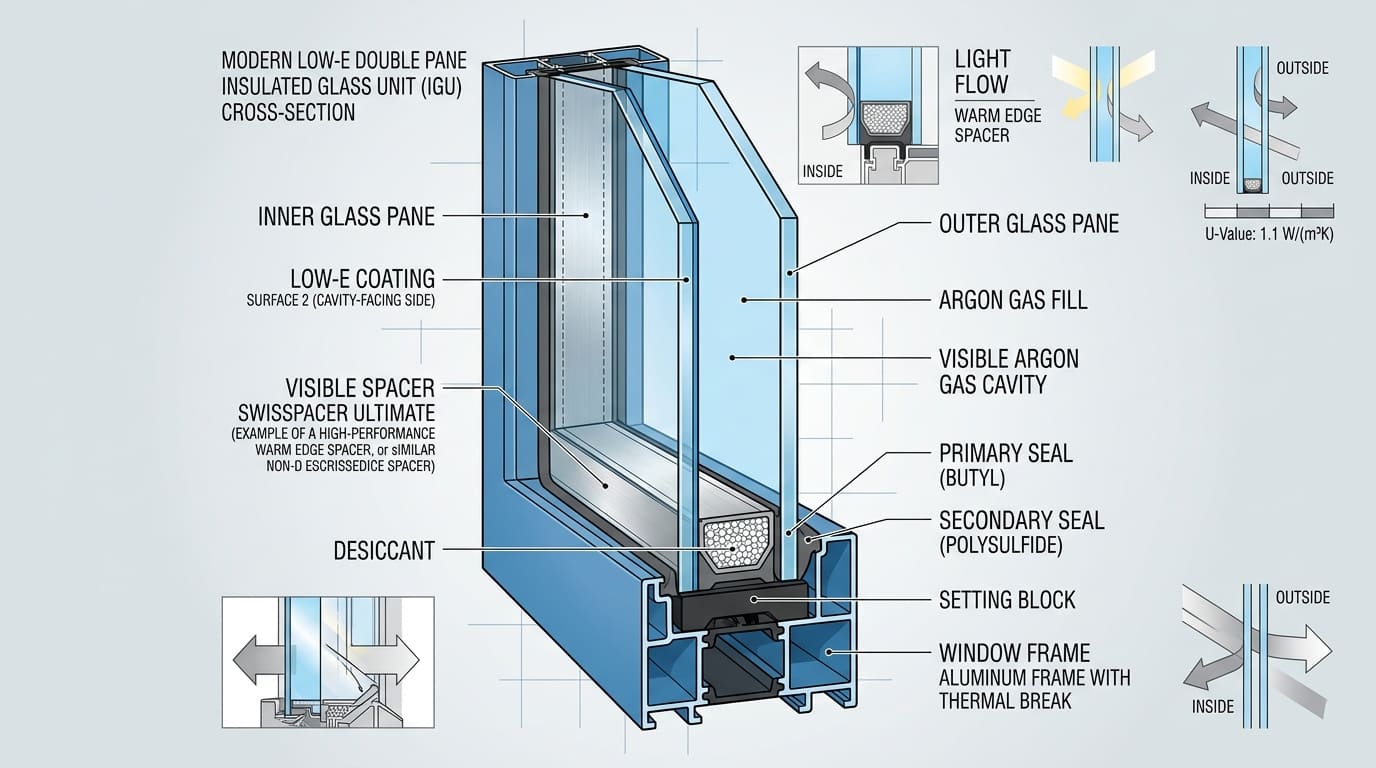
Energy-Efficient Glass Upgrades for DMV Homes: Low-E, Argon & Beyond
10 min read
Low-E Glass Explained: Is It Worth the Upgrade for Your DMV Home?
7 min read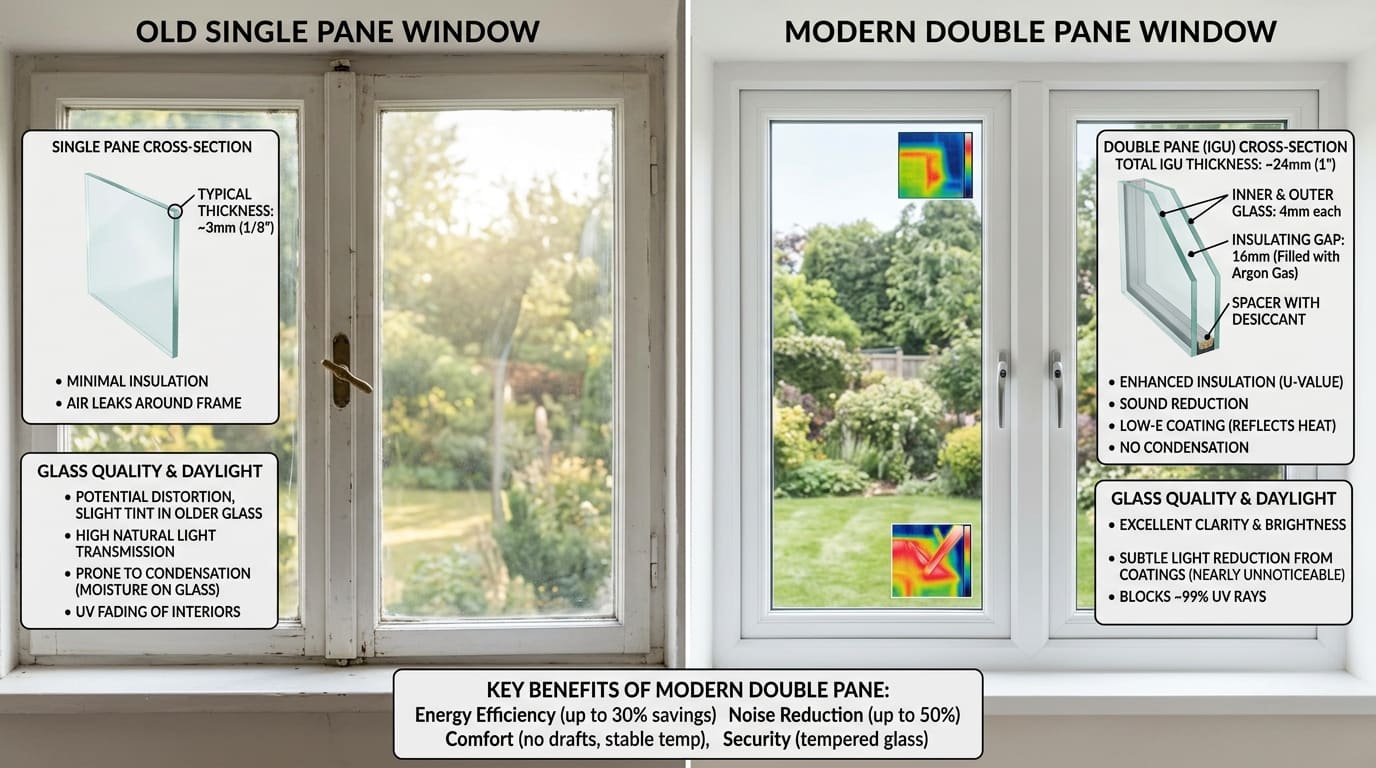
When to Upgrade from Single-Pane to Double-Pane Windows in the DMV
8 min read
How Glass Replacement Saves Money on Energy Bills in the DMV
7 min readExplore More Resources
Helpful Guides
Common Problems
24/7 Emergency
Board-Up & Glass
Licensed & Insured
DC, MD & VA
300+ Areas
DMV Coverage
Same-Day Service
When You Need It
Ready to Get Started?
Get a free estimate for any window or glass service across the DMV area.