Argon vs. Krypton Gas in Insulated Glass Units: What DMV Homeowners Need to Know
Argon or krypton gas fill for your insulated glass unit? Virginia Glass Windows explains performance differences, cost comparison, DMV climate recommendations, and gas retention facts.
Why Gas Fill Matters in Insulated Windows
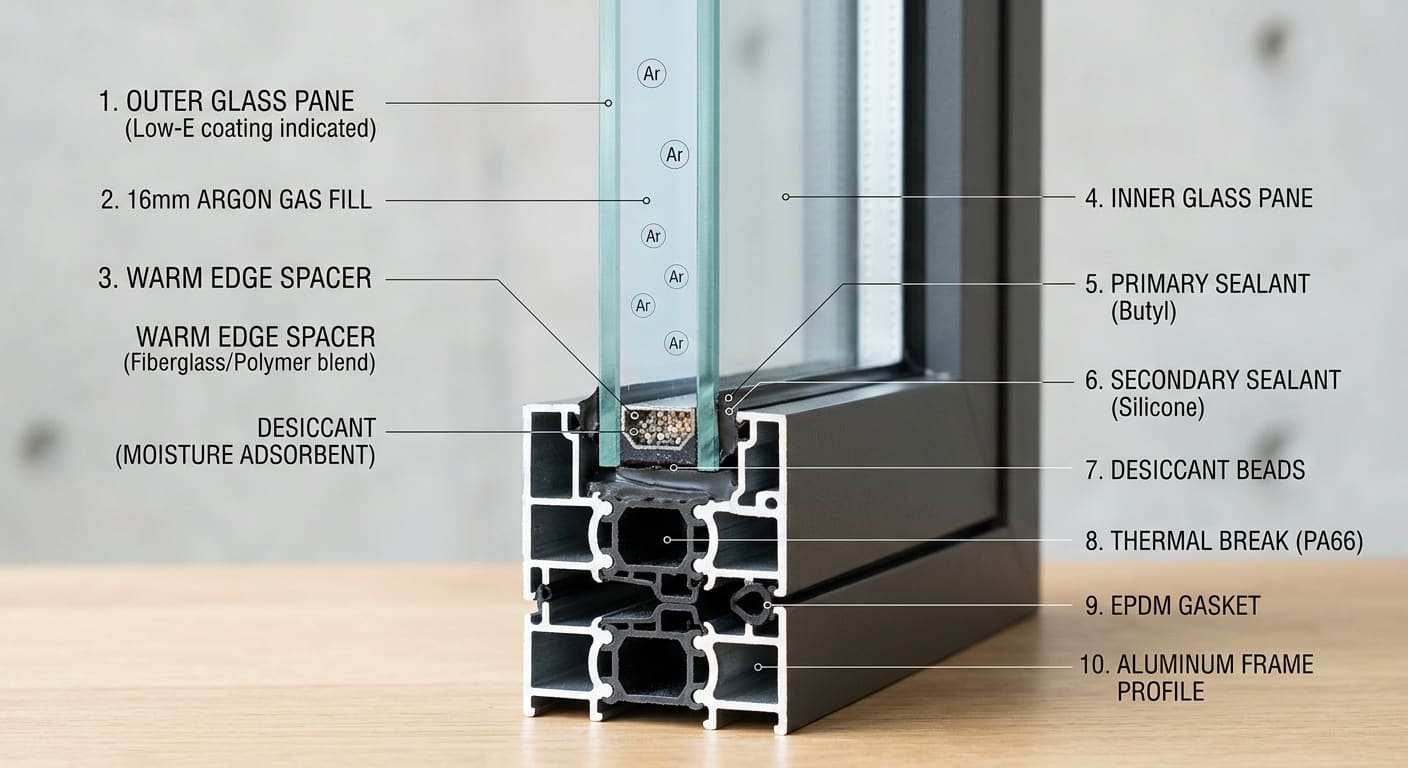
Modern insulated glass units (IGUs) are not simply two panes of glass with air between them. They are precision-engineered assemblies sealed with primary and secondary sealants, fitted with warm-edge spacers containing moisture-absorbing desiccant, and filled with an insulating gas that is specifically chosen for its thermal performance characteristics. The gas fill — whether air, argon, or krypton — is a meaningful component of the IGU's overall energy performance, and understanding the options helps DMV homeowners make better decisions when replacing failed IGUs or upgrading windows.
In the context of insulated glass performance, thermal conductivity is the key gas property. The primary mode of heat transfer through the gas-filled cavity is convection (warm gas rising, cool gas sinking, creating circulation that moves heat across the cavity) and conduction through the gas itself. Denser gases with lower thermal conductivity reduce both convection and conduction, improving the IGU's thermal resistance. Both argon and krypton are denser than air and conduct heat less efficiently — krypton more so than argon — which is why both are used as superior alternatives to air fill.
Argon Gas: The Standard Choice
Argon is the standard gas fill for quality residential insulated glass units throughout the DMV market and across North America. It is the fourth most abundant gas in the Earth's atmosphere (approximately 1 percent of air by volume), which makes it extraordinarily abundant and inexpensive to produce — essentially a byproduct of air separation processes that produce oxygen and nitrogen for industrial use. This abundance keeps argon's cost contribution to an IGU minimal: upgrading from air fill to argon fill adds a few dollars to the cost of a standard residential window unit, a cost that Virginia Glass Windows includes as standard in all replacement IGUs.
Argon's thermal performance advantage over air is meaningful but not dramatic. Argon's thermal conductivity is approximately 67 percent that of air — meaning it conducts heat about one-third less efficiently. For a standard 1/2-inch (12mm) air gap in a double-pane IGU, replacing air with argon improves the center-of-glass R-value by approximately 15 to 20 percent. In practical terms, a double-pane unit with air fill might achieve a center-of-glass R-value of about 2.0; the same unit with argon achieves approximately R-2.3 to R-2.5. Combined with a Low-E coating, a double-pane argon-filled IGU reaches the R-3.0 to R-4.0 range that represents the current standard for energy-efficient residential windows in the DMV.
Argon works best in standard cavity widths of 1/2 inch to 3/4 inch (12 to 19mm). Cavities narrower than 1/2 inch allow less space for the insulating gas layer to function effectively. Cavities wider than 3/4 inch in a single-cavity IGU begin to allow increased convection — the gas has enough space to circulate, actually worsening thermal performance. The optimal argon cavity width for maximum performance is approximately 1/2 to 5/8 inch. If you are having IGUs replaced in your DMV home, discuss cavity width with your glass technician to confirm the specification aligns with optimal performance.
Krypton Gas: The Premium Option
Krypton is a noble gas like argon but significantly denser and a poorer heat conductor — krypton's thermal conductivity is approximately 36 percent that of air, compared to argon's 67 percent. This superior thermal performance makes krypton the gas of choice in two specific situations: narrow-cavity IGUs where argon cannot fully express its performance advantage, and triple-pane IGUs where the total unit thickness is a constraining factor.
The critical practical advantage of krypton over argon is its superior performance in narrow cavities. Krypton reaches optimal thermal performance at cavity widths as narrow as 1/4 inch (6mm) — less than half the optimal argon cavity width. This makes krypton the enabling technology for thin-profile triple-pane IGUs where total glass thickness must be minimized to fit in existing window frames. A triple-pane unit with three glass layers and two narrow krypton-filled cavities can achieve R-5.0 or higher in an overall thickness of only 7/8 to 1 inch — thin enough to retrofit into many existing window frames that would not accommodate a thicker triple-pane unit. For DMV homeowners interested in triple-pane glass without full window replacement, krypton-filled units often make the difference between feasibility and infeasibility.
The significant disadvantage of krypton is cost. Krypton is present in the atmosphere at only about 1 part per million — roughly 700 times less abundant than argon. Extracting krypton in commercial quantities from air requires extensive processing, making it 50 to 100 times more expensive than argon per unit volume. This cost difference translates directly to window pricing: krypton-filled IGUs cost noticeably more than equivalent argon-filled units. For standard double-pane residential windows, the additional cost of krypton is not justified — argon provides excellent performance at the cavity widths used in standard residential IGUs. Reserve krypton for triple-pane applications and retrofit situations where narrow cavities are required.
Gas Retention Over Time
A common concern among DMV homeowners is how well the gas fill is retained over the life of an IGU. The answer is reassuring: quality IGUs retain the vast majority of their gas fill for their rated service life. Research by glass industry organizations indicates that well-manufactured IGUs with appropriate sealants retain approximately 1 percent of their gas volume per year or less — meaning a unit starting at 90 percent argon fill loses only about 1 percentage point per year, maintaining meaningful insulating value for 15 to 25 years or more.
The primary factor determining gas retention is the quality of the edge seal system. IGUs use a dual-seal construction: a primary seal of polyisobutylene (PIB) pressed against the spacer provides gas and moisture impermeability, and a secondary structural seal of silicone or polyurethane provides mechanical strength to hold the unit together. Both sealants must remain intact for gas retention to remain good. UV exposure, thermal cycling, and manufacturing defects are the primary causes of seal degradation over time.
There is no practical field method for refilling the gas in a failed or depleted IGU — the unit must be opened to fill it, which destroys the seals, and even if filled outside the factory, maintaining the proper gas concentration and seal integrity during reassembly is extremely difficult. When gas retention is a concern — particularly for units more than 15 to 20 years old — the correct approach is replacement with a new factory-manufactured argon-filled IGU. Our <a href="/services/insulated-glass-repair">insulated glass service</a> covers IGU replacement throughout the DMV.
DMV Climate Recommendations
For the vast majority of residential window glass replacements in the DC, Maryland, and Virginia area, argon-filled double-pane IGUs with Low-E coating are the correct specification. This combination provides excellent energy performance appropriate to the DMV's mixed heating-cooling climate, uses proven and cost-effective technology, and meets or exceeds Energy Star requirements for the region. The incremental benefit of krypton fill in a standard-width double-pane residential IGU does not justify its additional cost.
Krypton fill makes sense in the DMV for specific retrofit situations: when replacing IGUs in existing frames with shallow glass pockets that can only accommodate thin IGUs, when specifying triple-pane units for north-facing rooms with chronic cold comfort issues, and for high-performance homes pursuing Passive House or zero-energy building certifications where maximum window performance is required. For the typical homeowner replacing foggy or failed IGUs in standard residential windows, argon fill is the right choice.
When shopping for replacement IGUs, confirm the gas fill with your glass supplier and request documentation. Some budget suppliers use air-fill units without disclosing this to customers. All replacement IGUs supplied by Virginia Glass Windows include argon fill as standard — we confirm this on our written quotes. Visit <a href="/guides/insulated-glass-unit-guide">our IGU guide</a> or call (703) 470-7867 for a free consultation on your window glass replacement project.
Need Help With Your Glass?
Send us a photo of your window or glass issue and get a free estimate within hours. Our experts serve all of DC, Maryland, and Virginia.
Common Questions
Frequently Asked Questions
Answers to common questions about this topic from our DMV glass experts.
Keep Reading
Related Guides
Explore More Resources
Related Articles
Common Problems
Related Pages
Ready to Get Started?
Get a free estimate from our glass experts. Same-day service available across DC, MD & VA.