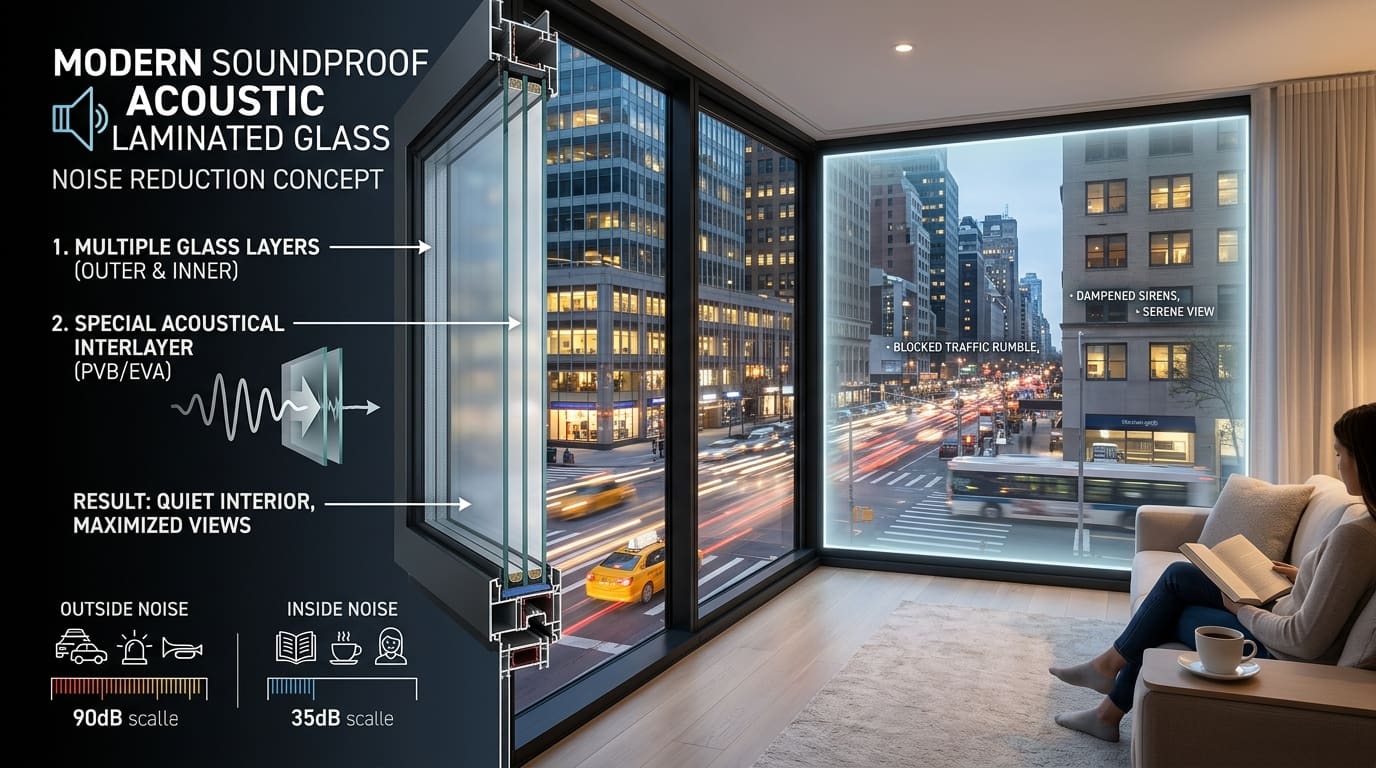
Acoustic Glass for DMV Homes Near DCA, Dulles, and BWI Airports
Aircraft noise is one of the most persistent quality-of-life issues for homeowners near DCA, Dulles, and BWI. The good news is that the right glass specification can reduce that noise dramatically — more than most homeowners expect.
Mike Reynolds
Lead Glass Technician & Owner
In This Article
The Airport Noise Problem in the DMV
Three major commercial airports serve the Washington DC metropolitan area, and all three have noise impact zones that extend through established residential neighborhoods. Reagan National Airport (DCA) sits directly at the confluence of DC, Arlington, and Alexandria — the flight paths over Alexandria's Del Ray neighborhood, Arlington's Crystal City, and the Anacostia corridor in DC are among the most impacted in the region. Dulles International Airport's flight paths extend across large portions of Loudoun and Fairfax Counties. BWI's patterns reach into Anne Arundel and Howard Counties in Maryland, with parts of College Park and Bowie experiencing meaningful aircraft noise exposure.
The homeowners I work with in these noise zones often describe aircraft noise as their single largest quality-of-life issue — more disruptive than traffic, more predictable than intermittent construction, more persistent than neighborhood sound. And unlike many noise sources, aircraft noise includes low-frequency components (the deep rumble of jet engines during climb-out) that penetrate standard building construction very effectively. Standard double-pane windows — which do a reasonable job with mid-frequency sound — do relatively little to reduce the low-frequency components of aircraft noise that most people find most intrusive.
How Sound Travels Through Glass
Sound transmission through glass depends on the glass mass, the stiffness of the glass, and any damping materials in the glass assembly. Standard glass transmits sound through the glass-air-glass system in a way that creates specific frequencies at which the glass assembly resonates and transmits sound with almost no attenuation — called the coincidence dip. This is why standard double-pane glass is often less effective at certain mid-frequencies than single-pane glass of the same total mass — the air cavity creates resonance that allows sound through at specific frequencies.
The STC (Sound Transmission Class) rating is the standard measurement of glass (and other building assemblies) acoustic performance. Higher STC means less sound transmission. Standard single-pane 1/4-inch glass is approximately STC 28. Standard double-pane 1-inch clear IGU is approximately STC 26 to 28 — not much better, and sometimes worse, than single-pane because of the cavity resonance. This is a counterintuitive result that surprises many homeowners who assume double-pane means better sound control.
Acoustic performance requires different strategies: mass asymmetry (using different thickness glass lites in the two layers of an IGU), laminated glass (adding the damping of the PVB interlayer), gas fill with good acoustic properties, and wider air cavities (which shift the resonance to lower frequencies outside the range of most noise concerns). The right combination depends on the specific noise spectrum — aircraft noise has different characteristics than traffic noise or neighborhood sound.
Laminated Acoustic Glass: The Core Upgrade
The single most effective glass improvement for acoustic performance is replacing standard annealed glass with acoustic laminated glass. The PVB interlayer in laminated glass is a viscoelastic material that converts sound energy to heat through internal friction — it acts as a damping layer that breaks the direct mechanical coupling between the outer glass surface and the inner glass surface that standard annealed glass provides.
Standard PVB laminated glass (the same type used for automotive windshields) provides approximately 3 to 5 STC improvement over equivalent clear glass. Acoustic-grade PVB — a specially formulated interlayer with higher acoustic damping properties — provides 8 to 12 STC improvement. For aircraft noise reduction in DMV neighborhoods, acoustic-grade laminated glass is the specification we recommend.
A practical example: a homeowner in Alexandria's Aurora Hills neighborhood near a DCA flight path replacing standard double-pane clear windows with double-pane acoustic laminated glass (acoustic PVB outer lite, clear tempered inner lite, argon fill) might see the window STC rating improve from approximately 28 to 38 to 40. An improvement of 10 to 12 STC corresponds to approximately a 50 to 60 percent reduction in perceived loudness — the difference between a noise that dominates the room and a noise that is present but not disruptive.
Mass Asymmetry: The Often-Overlooked Improvement
In a standard IGU, both glass lites are typically the same thickness — most commonly 3mm-3mm or 4mm-4mm. When both lites are the same thickness, they resonate at the same frequency and the system transmits sound at that resonance frequency with minimal attenuation. Using different thickness lites — the mass asymmetry approach — moves each lite's resonance frequency to a different point, so there is no frequency at which both lites resonate simultaneously. This dramatically reduces the coincidence dip and improves mid-frequency performance significantly.
For airport noise applications, we typically specify an IGU with a 6mm outer lite and a 4mm inner lite rather than two 5mm lites of equal thickness. When the outer lite is also acoustic laminated glass, the combination of mass asymmetry and acoustic interlayer damping produces window acoustic performance that is significantly better than any same-thickness combination could achieve. This is the specification we use for serious acoustic glass projects in DMV airport noise zones.
Window System vs. Glass-Only Acoustic Performance
It is important to understand that the acoustic performance of a window system depends on the weakest link, not just the glass specification. A high-performance acoustic laminated IGU installed in a frame with poor air sealing will underperform relative to its glass rating — sound that does not transmit through the glass will transmit through the air infiltration paths around the frame instead.
For airport noise applications where the glass upgrade is being made specifically for acoustic performance, the installation quality of the glass — the completeness and quality of the weatherstripping and frame sealing — matters as much as the glass specification. We use high-performance acoustic sealants at the glass-to-frame interface in these applications, and we verify that all air infiltration paths in the window frame system are addressed before or as part of the glass replacement work.
The other component that frequently limits acoustic performance in older DMV homes is doors — particularly older steel or hollow-core wood entry doors in homes near flight paths. Upgrading windows without addressing door acoustic performance limits the total result. For homeowners making a comprehensive acoustic improvement, the assessment should cover all openings in the building envelope, not just windows.
FAA Noise Mitigation Programs
Homeowners in the highest-impact noise zones around DCA, Dulles, and BWI may be eligible for FAA-funded noise mitigation programs that provide acoustic insulation improvements — including window glass upgrades — at reduced or no cost. The FAA Part 150 noise compatibility programs for each airport periodically fund sound insulation projects in the highest-DNL noise contours.
Eligibility is determined by noise contour (typically 65 DNL or higher is the entry point for most programs) and program availability. These programs run in phases with limited enrollment windows. If you are in a high-impact noise zone and are considering acoustic glass upgrades, it is worth checking whether your property is within an active FAA noise mitigation program before proceeding with private-pay glass replacement — the programs can cover substantial portions of the cost for eligible properties.
Contact the Metropolitan Washington Airports Authority (MWAA) for DCA and Dulles program information, or the BWI Airport Noise Mitigation Program for BWI-related eligibility. Call us at (703) 470-7867 to discuss acoustic glass specifications for your specific address and noise exposure situation.
About the Author
Mike Reynolds
Lead Glass Technician & Owner
With over 15 years of experience in window and glass repair across the DC, Maryland, and Virginia area, Mike shares practical expertise to help homeowners and businesses make informed decisions about their glass repair and replacement needs.
Need Help With Your Glass?
Our experts are ready to help with any window or glass issue. Free estimates, same-day service available across DC, MD & VA.
Related Articles
Continue reading about energy efficiency
 Safety
Why Laminated Glass Is the Best Security Upgrade You Can Make to Your DMV Home
 Energy Efficiency
Energy-Efficient Glass Upgrades for DMV Homes: Low-E, Argon & Beyond
 Energy Efficiency
NFRC Window Ratings Explained: What the Numbers Actually Mean for Your DMV Home
More Energy Efficiency
View AllEnergy-Efficient Glass Upgrades for DMV Homes: Low-E, Argon & Beyond
10 min read
Low-E Glass Explained: Is It Worth the Upgrade for Your DMV Home?
7 min read
When to Upgrade from Single-Pane to Double-Pane Windows in the DMV
8 min readHow Glass Replacement Saves Money on Energy Bills in the DMV
7 min readExplore More Resources
Helpful Guides
Common Problems
Related Pages
Our Services
24/7 Emergency
Board-Up & Glass
Licensed & Insured
DC, MD & VA
300+ Areas
DMV Coverage
Same-Day Service
When You Need It
Ready to Get Started?
Get a free estimate for any window or glass service across the DMV area.