Storm & Impact-Resistant Glass for DMV Homes: Derechos, Wind Events & Severe Weather Protection
Impact-resistant and storm glass for DC, Maryland, and Virginia homes. Derecho protection, hurricane remnants, wind-borne debris. Expert service from Virginia Glass Windows.
The DMV Is Not a Hurricane Zone — But Your Windows Still Need to Handle Severe Weather
People hear "impact-resistant glass" and think Florida. Understandable. But the DMV gets hit by serious wind events every single year, and the window failures we respond to after those events are a reminder that standard residential glass has real limits. Derecho storms — those fast-moving, long-lived windstorm complexes that march across the mid-Atlantic — are the biggest threat. The June 2012 derecho brought sustained winds of 70 to 80 mph across the DC suburbs and caused catastrophic window damage from Rockville down through Prince George's County. We were doing emergency board-ups for weeks after that event.
The DMV also sits in the path of weakening tropical systems. Hurricane Isabelle in 2003, the remnants of Hurricane Ida in 2021, and several tropical depressions each year bring sustained winds of 40 to 60 mph with gusts well above that. These events are not category-5 Florida scenarios, but 60 mph wind-borne debris from a neighbor's fence or a downed tree branch will destroy standard residential glass just as effectively as a coastal storm surge. And unlike Florida, most DMV homeowners have never considered impact glass as an option.
This guide is for DMV homeowners who want to understand their options for improving window performance against the actual severe weather threats in our region. We are not selling fear — most standard windows handle most storms fine. But for exposed exposures, for homes with large glass areas, or for families who have lived through a bad storm and know what glass failure feels like, there are meaningful upgrades available.
How Impact-Resistant Glass Actually Works
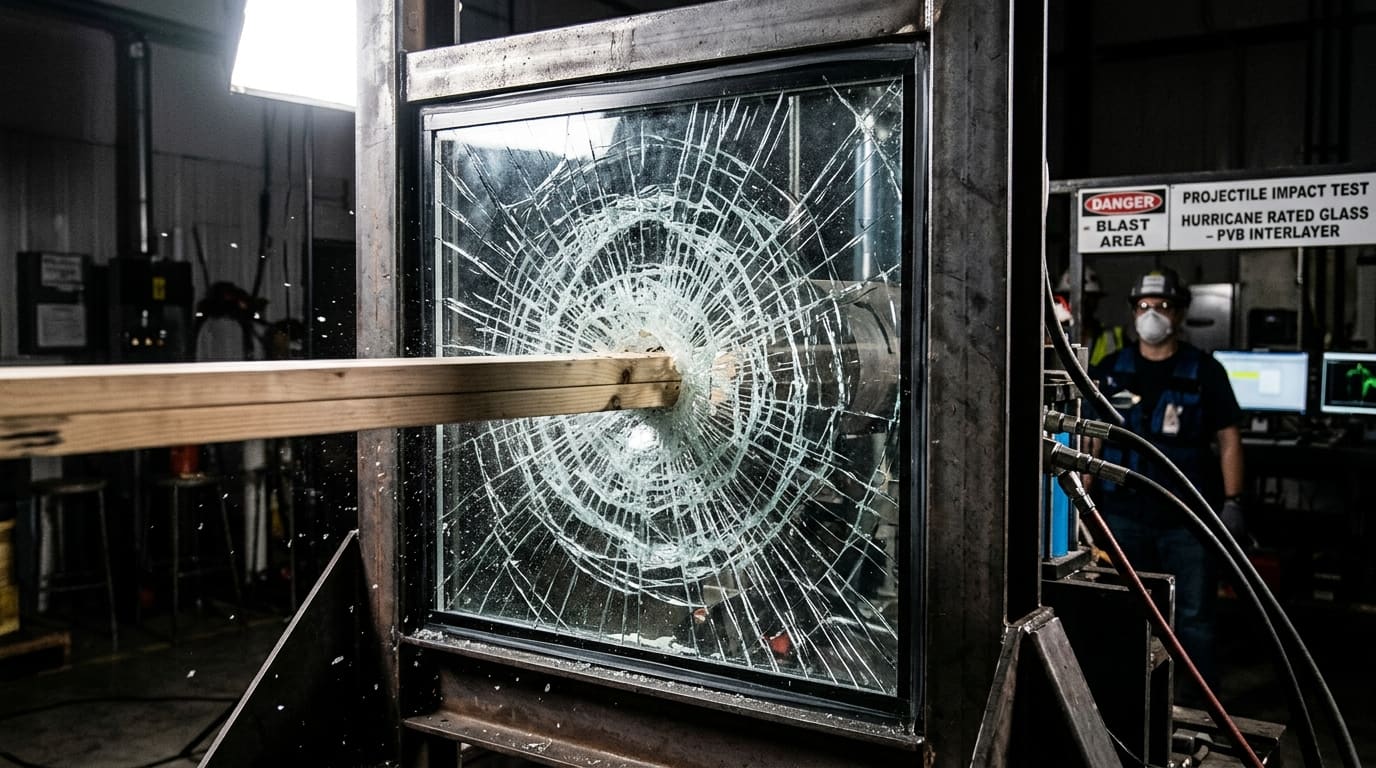
The term "impact-resistant glass" specifically refers to laminated glass constructed with a PVB (polyvinyl butyral) or SGP (SentryGlas Plus) interlayer between two glass plies. When the glass is struck — by a wind-borne 2x4 at 35 mph in a Florida test, or a tree branch in a Montgomery County derecho — the outer glass ply shatters but the interlayer holds the fragments in place. The window may crack, but it does not blow out. The building envelope remains intact, interior pressure is maintained, and rain and wind stay outside.
The strength of the interlayer determines the performance level. Standard PVB interlayer (the same material used in automotive windshields) provides basic impact resistance and is the most common specification. SGP interlayer is significantly stiffer and stronger — roughly five times the tear strength of standard PVB — and is used in high-performance impact products and structural glass applications. For DMV residential applications, laminated glass with standard PVB provides substantial improvement over standard annealed or tempered glass; SGP is specified for larger glass areas where structural performance is critical.
It is important to distinguish impact-resistant glass from "impact windows" marketed in Florida and coastal markets. Florida-rated impact windows must pass ASTM E1996 large-missile impact testing — a 9-pound 2x4 fired at the glass at 50 fps. That is the standard for hurricane zones. In the DMV, we are not typically specifying Florida hurricane-rated windows; instead, we are specifying laminated glass that provides meaningful real-world performance improvement against the wind-borne debris, branch strikes, and pressure loading that our regional weather actually delivers.
Derecho and Severe Thunderstorm Glass Failures
The failure mode we see most often after DMV wind events is not direct impact — it is pressure-induced glass flex and seal failure. When a fast-moving storm cell passes over a neighborhood, it creates rapid pressure differentials. Standard double-pane glass units are designed for a certain pressure load, and when that load is exceeded by a derecho event, the glass can bow inward enough to crack or pop the seal on the IGU. The glass does not shatter dramatically — it develops a crack from a corner or pops a seal — but the unit is compromised and needs replacement.
Branch strikes are the other major cause of post-storm glass damage in the DMV. We are a heavily treed region, and mature oaks and maples in Montgomery County, Fairfax, and Prince George's County drop significant limb mass in wind events. A 2-inch diameter branch falling from 40 feet has the energy to shatter any standard residential glass unit it hits. After the August 2020 derecho that tracked through the Northern Virginia suburbs, we responded to dozens of branch-strike window failures from Vienna to Falls Church.
The third mechanism is pressure cycling in sustained wind — windows on the windward side of a home experience repeated positive pressure loading as gusts hit, then negative pressure (suction) as the gust passes. This rapid cycling fatigues the IGU seals and in severe events can pop the glass unit out of its glazing channel entirely. Larger glass panels are most vulnerable to this mechanism. For homeowners with large picture windows or sliding glass doors facing the prevailing storm direction — typically northwest to southwest in DMV wind events — laminated glass is a meaningful upgrade.
Selecting the Right Storm Glass for Your Home
The right specification depends on your exposure, the size of your glass panels, and the value you are protecting. For a typical DMV colonial with standard-sized double-hung windows and tree buffering on all sides, upgrading to laminated glass provides meaningful peace of mind but is not urgent. For a home on a ridge in Loudoun County with no tree buffering and large west-facing glass panels, laminated glass is a practical investment that will pay off the first time a bad line of storms comes through.
For sliding glass doors and large picture windows — the most vulnerable openings in most DMV homes — we strongly recommend at minimum laminated glass in the outer lite of the insulated glass unit. The outer lite is the one that takes the direct strike from wind-borne debris. Making that ply laminated provides immediate benefit without adding significant thickness or weight to the unit. The inner lite can remain standard tempered glass, which is appropriate for safety glazing at floor level.
For a higher performance specification — homes in open exposures, properties that have experienced previous storm damage, or clients who simply want the best available protection — we specify laminated glass on both lites of the IGU with an SGP interlayer on the outer ply. This configuration performs comparably to Florida-rated impact products in independent testing against the wind-borne debris threats relevant to our region. Virginia Glass Windows can assess your specific home, identify the highest-risk openings, and provide a prioritized recommendation.
Emergency Board-Up and Temporary Protection
When a storm breaks your windows, immediate action matters. Open window openings allow rain to enter and cause significant secondary water damage in minutes. Structural sheathing, electrical systems, floors, and contents are all vulnerable. In a severe storm event, professional emergency board-up is often the fastest way to secure the opening while permanent glass is ordered.
Virginia Glass Windows provides 24/7 emergency board-up service across the DMV. Our crews are equipped to board standard residential windows, sliding glass doors, and storefront glass. We use structural plywood and proper fastening techniques — not just a sheet of OSB duct-taped in place. Our board-ups are weather-tight enough to allow you to safely remain in the home while we arrange permanent glass replacement.
Temporary window film and clear security panels are sometimes used as an alternative to opaque board-up when appearance matters — a street-facing window on a home listed for sale, for example, or a commercial storefront that needs to remain open for business. Virginia Glass Windows can assess whether these alternatives are appropriate for your specific opening and secure a temporary measure while we fabricate or source the permanent glass. Call (703) 470-7867 any hour for emergency board-up.
Balancing Storm Protection with Energy Performance
A question we get frequently: do I have to choose between impact performance and energy performance? The answer is no — you can have both, but you need to spec carefully. Standard laminated glass without a low-E coating has inferior energy performance to a standard low-E IGU. However, laminated glass is perfectly compatible with low-E coatings. We routinely supply laminated low-E IGUs that meet current IECC energy code requirements for the DMV while providing significantly better impact performance than standard double-pane units.
The key specification is where the low-E coating is placed in a laminated IGU. In a standard double-pane unit, the low-E coating is on surface 3 (inner face of the outer pane) or surface 2. In a laminated IGU where the outer lite is laminated, the coating placement may shift to maintain optimal performance. Virginia Glass Windows works with our glass suppliers to ensure that laminated storm glass products meet the energy performance requirements appropriate for your home.
For homes where storm protection is a priority, we often recommend reviewing all glass openings systematically — identifying which ones are highest risk based on size, orientation, and tree exposure — and upgrading those selectively to laminated low-E. This targeted approach provides the most meaningful storm protection improvement for the investment. Contact us at (703) 470-7867 or request a free photo estimate to discuss your specific home.
Need Help With Your Glass?
Send us a photo of your window or glass issue and get a free estimate within hours. Our experts serve all of DC, Maryland, and Virginia.
Common Questions
Frequently Asked Questions
Answers to common questions about this topic from our DMV glass experts.
Keep Reading
Related Guides
Related Services
Explore More Resources
Related Articles
Common Problems
Our Services
Ready to Get Started?
Get a free estimate from our glass experts. Same-day service available across DC, MD & VA.