
Sunroom Glass Options for the DMV Climate: What Works and What Fails
A sunroom in the DMV has to handle some of the most demanding glass conditions on the East Coast — summer afternoons that can hit 95°F plus direct solar gain, winters with ice storms and single-digit wind chills, and the wildcard of mid-Atlantic humidity all year round.
Mike Reynolds
Lead Glass Technician & Owner
In This Article
Why the DMV Climate Is Demanding for Sunroom Glass
The DC-Maryland-Virginia region sits in a genuinely challenging climatic zone for sunrooms. It is hot enough in summer — regularly 90°F+ with high humidity from July through August — that solar heat gain through unprotected glass creates uncomfortable, unusable spaces. But it is cold enough in winter — January average lows below 30°F in most of the region, with temperature swings of 40-50°F common during cold fronts — that thermal performance through glass matters for heating costs and comfort. Ice storms, which the DMV gets several times per decade in bad years, put mechanical and thermal stress on overhead glass installations. And the spring and fall humidity cycles mean moisture management around glass seals is a year-round concern.
Sunrooms that perform well in Southern California or coastal Florida often underperform in the DMV climate because they were designed for milder conditions. The glass specifications that work for a sunroom in Phoenix (primarily solar control) are different from the specifications for a sunroom in Rockville or Reston (solar control plus winter insulation plus ice load capacity).
Overhead (Roof) Glass: The Most Critical Choice
Overhead glass in a sunroom — roof panels, skylights, or sloped glazing — is the most critical glass specification decision and the area where the most failures occur. The issues with overhead glass in the DMV are:
Thermal stress from intense direct sun exposure. Overhead glass in the DMV can reach 150-180°F on the glass surface during summer afternoons. For standard single-lite glass, this is a significant stress. For IGUs, the trapped air between lites expands dramatically at these temperatures, putting pressure on the seals and spacer system. Overhead IGUs have higher seal failure rates than vertical IGUs in the DMV climate — the combination of temperature extremes, condensation cycles, and the challenge of sealing on a non-vertical surface makes overhead IGU seals work harder.
Water management. Overhead glass installation depends heavily on the quality of the glazing system — the frame, seals, and weatherproofing that keeps water out. In the DMV, where significant rainfall (averaging around 40 inches per year) combines with freeze-thaw cycles, overhead glass sealant systems degrade faster than vertical ones and require periodic inspection and maintenance. A leaking overhead glass panel in a sunroom creates interior water damage quickly.
Ice and snow load. While the DMV is not a heavy snow region, ice storms create localized load conditions that can be severe. A thick ice accumulation on overhead glass panels — common after the freezing rain events the region experiences several times per decade — creates load and thermal stress that overhead glass must be sized for.
For overhead glazing, our recommendation for DMV sunrooms is tempered laminated glass with a minimum thickness of 3/8 inch (10mm) for spans up to 4 feet, and 1/2 inch (12mm) for longer spans. Laminated glass is required by code for all overhead applications; the retained-in-place failure behavior is critical for life safety. Tempered-laminated combines the high strength of tempered with the retained-in-place safety of laminated.
Wall Glass: Solar Control Is the Primary Issue
For the vertical glass panels in sunroom walls, solar heat gain coefficient (SHGC) is the most important performance parameter for DMV conditions. A south or west-facing sunroom wall with standard clear glass and no shading can admit enough solar energy on an August afternoon to raise the room temperature 30-40°F above the ambient outdoor temperature — making the space genuinely unusable without air conditioning.
Low-SHGC glass — specifically Low-E glass with a SHGC of 0.25 or lower for south and west-facing applications — dramatically reduces solar heat gain while maintaining visible light transmission. The practical difference: a sunroom with clear glass at SHGC 0.87 becomes an oven in summer; the same sunroom with SHGC 0.25 glass stays significantly cooler on the same day with the same sun exposure.
The trade-off for low-SHGC glass is reduced passive solar gain in winter — the same glass that blocks summer heat also blocks some of the winter sun warmth you might want. For sunrooms intended as year-round living spaces in the DMV, a balanced SHGC in the 0.30-0.40 range is often the right compromise for south-facing glass. For east and north-facing walls, a higher SHGC is appropriate because the summer sun exposure is lower.
Insulated Glass Units for Sunroom Comfort
Single-pane glass in a sunroom wall is genuinely inadequate for year-round comfort in the DMV. In winter, single-pane glass has a U-factor around 1.0, compared to 0.25-0.35 for a good double-pane Low-E unit. The difference in heat loss — and in the radiant discomfort of sitting near a cold glass surface — is substantial. A single-pane sunroom in January in Fairfax County or Montgomery County will feel cold within 2-3 feet of the glass regardless of the thermostat setting, because radiant heat loss from your body to the cold glass surface creates a perception of cold even when the air temperature is adequate.
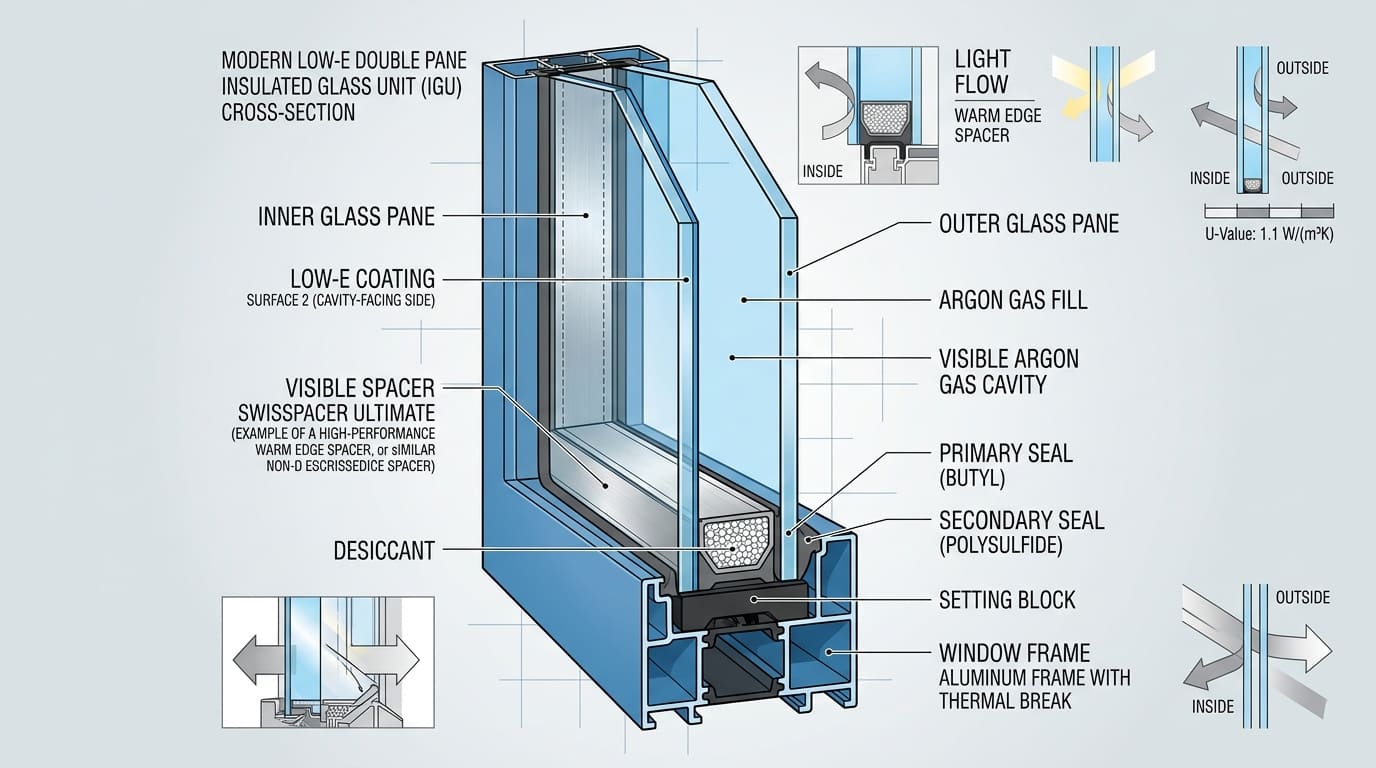
Double-pane IGUs with Low-E coating are the baseline specification for any sunroom intended for year-round DMV use. For three-season rooms (spring, summer, fall) where winter use is limited, single-pane glass with proper interior shading may be acceptable as a cost compromise. But the DMV winter is cold enough that single-pane sunrooms are genuinely uncomfortable in January-February for most households.
Polycarbonate Panel Sunrooms: The Alternative
Many sunroom additions in the DMV use multiwall polycarbonate panels rather than glass for the roof and sometimes the wall glazing. Polycarbonate is significantly lighter than glass, easier to work with for sloped overhead applications, and inherently a safety-glazing material without requiring tempering. Its thermal performance can be good with appropriate multiwall configurations.
The downside of polycarbonate is longevity — it yellows and becomes brittle with UV exposure over 10-20 years, and the plastic panels are much more susceptible to surface scratching than glass. For long-term sunroom investments, glass is the more durable and aesthetically stable choice. For lower-cost additions or structures that will be rebuilt or replaced within 15-20 years, polycarbonate is a reasonable value choice.
For sunroom glass repair, replacement, or new installation in DC, Maryland, and Northern Virginia, send photos of your space for a free custom assessment. Sunroom glass specifications require more detailed site evaluation than standard window replacement — the orientation, framing, and climate exposure all affect the right glass choice. Call (703) 470-7867 to discuss your project.
About the Author
Mike Reynolds
Lead Glass Technician & Owner
With over 15 years of experience in window and glass repair across the DC, Maryland, and Virginia area, Mike shares practical expertise to help homeowners and businesses make informed decisions about their glass repair and replacement needs.
Need Help With Your Glass?
Our experts are ready to help with any window or glass issue. Free estimates, same-day service available across DC, MD & VA.
Related Articles
Continue reading about guides


More Guides
View All
How to Tell If Your Window Glass Needs Repair or Replacement
8 min read
Stress Cracks in Windows: Causes, Prevention & Solutions for DMV Homeowners
7 min read
Foggy Windows: Why Double-Pane Seals Fail & What to Do About It
9 min read
Glass Replacement in Historic DMV Homes: Preservation Meets Performance
9 min readExplore More Resources
Helpful Guides
Common Problems
Related Pages
Our Services
24/7 Emergency
Board-Up & Glass
Licensed & Insured
DC, MD & VA
300+ Areas
DMV Coverage
Same-Day Service
When You Need It
Ready to Get Started?
Get a free estimate for any window or glass service across the DMV area.