Using Mirrors and Glass to Make Small DMV Apartments Feel Larger
The DMV has some of the smallest average apartment sizes on the East Coast — Capitol Hill studios, Dupont Circle one-bedrooms, Bethesda high-rise units where every square foot has been value-engineered to the minimum. Mirrors and glass are the most powerful design tools available for making these spaces feel larger and more livable.
Mike Reynolds
Lead Glass Technician & Owner
In This Article
Why Mirrors Work in Small Spaces
The effect of mirrors on perceived room size is not psychological — it is optical. A mirror creates a literal visual extension of the space by reflecting an accurate image of the room behind the viewer. In a small DC apartment where the living area is 12 feet by 14 feet, a full-width mirror on one wall effectively doubles the visual depth of the room. Your eye processes the reflected space as continuous with the actual space, and the brain registers a room that appears twice as large as it actually is. This is not a trick or an illusion in the pejorative sense — it is a fundamental property of how human visual processing works, and it is one of the most cost-effective design tools in a space-constrained environment.
Beyond simple reflection, mirrors in small spaces serve several interconnected design functions. They amplify available light, making rooms brighter without additional lighting. They create the impression of depth in rooms with no windows on one wall — a common condition in urban apartments where three walls may be interior. They can visually balance asymmetric room layouts by reflecting the more open side back across the room. And in specific configurations, they can make a narrow hallway or galley kitchen feel significantly wider.
The most effective mirror placements in small DMV apartments share a common characteristic: they reflect something worth reflecting. A mirror that faces a blank wall reflects a blank wall and doubles the blandness. A mirror that faces a window reflects the outdoors and doubles the light and view. A mirror positioned to reflect an interesting piece of art or a stylish furniture arrangement multiplies the visual interest of those elements. Strategic placement of what the mirror reflects is at least as important as the mirror itself.
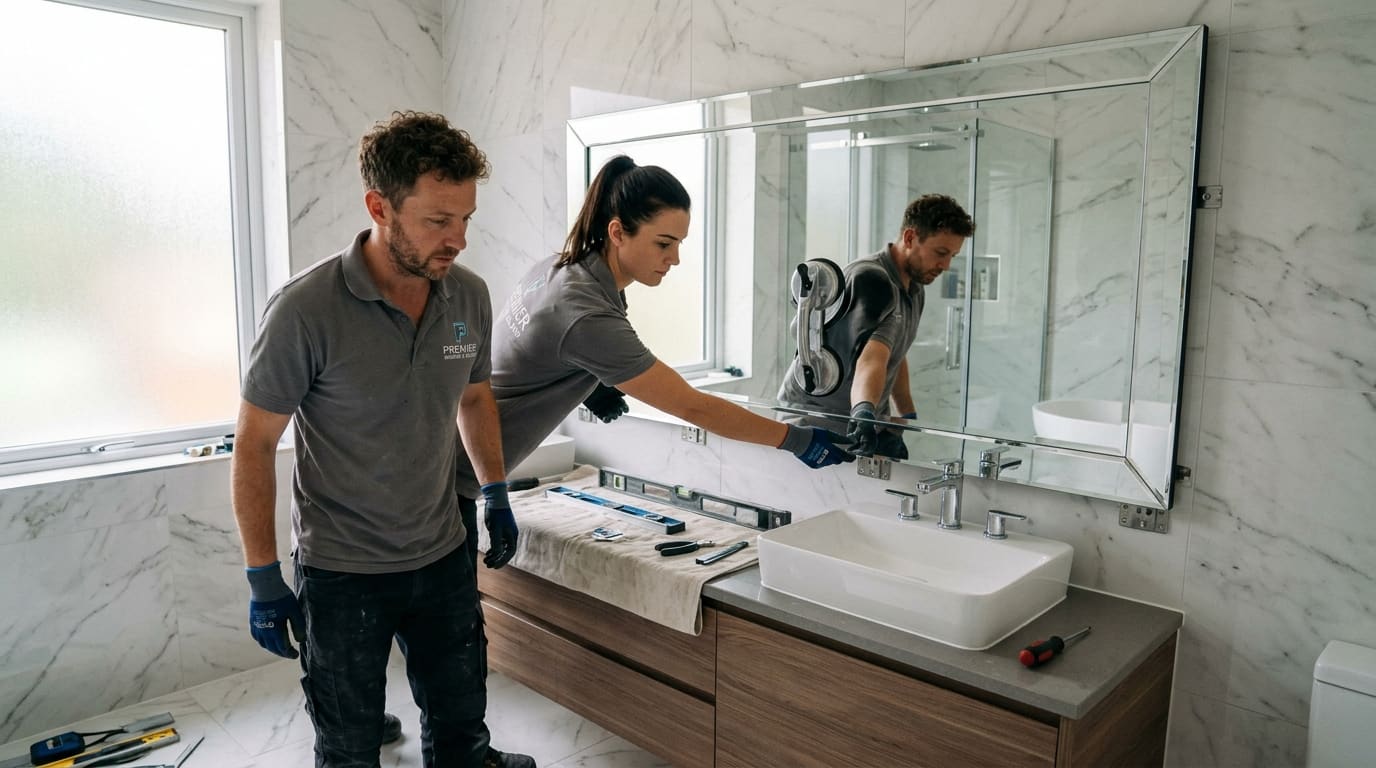
Mirror Wall Installation: What It Involves
A mirror wall — a continuous mirror surface spanning one wall from floor to ceiling or sill to ceiling — is the most impactful single glass design intervention available in a small space. In a studio apartment in the U Street corridor or a one-bedroom in Crystal City, a full-height mirror wall on the narrow end of the room can transform the space from feeling cramped to feeling genuinely spacious. The effect is strongest when the mirror wall is on the wall directly opposite the entry point to the room, where the first visual impression the viewer receives is a doubled space.
Full mirror walls are installed using one of two approaches. Large individual mirror panels — typically cut in 36-inch or 48-inch widths to fit standard sheet glass sizes — are installed side by side with minimal joints between them. The joints, when properly aligned and polished, are largely invisible from normal viewing distances; what you see is a continuous reflective surface. The alternative is mirrored glass panels with beveled edges that create a subtle frame effect around each panel — a design choice that acknowledges the panel divisions and makes them a visual element rather than trying to minimize them.
Safety is a critical consideration in mirror wall installations. Large mirrors are extremely heavy — a 4-foot by 8-foot mirror panel weighs approximately 50 to 60 pounds — and must be anchored to wall studs or to a solid backing system that distributes the load appropriately. Mirror mastic adhesive alone is not sufficient for large installations; mechanical fasteners or a French cleat system must support the weight. In rental apartments, where drilling into walls may have restrictions, discuss the installation method with your building management before proceeding. In owned condos, verify that the wall construction will support the weight — concrete or masonry walls behind drywall in high-rise construction may require different anchoring techniques than wood-frame walls.
Strategic Mirror Placement for Maximum Effect
Beyond full mirror walls, strategic placement of individual mirrors and mirrored furniture can achieve significant spatial expansion effects with less investment and less commitment. A large single mirror — 36 by 48 inches or larger — placed on the wall adjacent to the primary window in a living room reflects both the window light and the outdoor view into the room, creating a secondary visual window effect that makes the room feel connected to the exterior on two sides rather than one.
Dining areas in small DMV apartments are a particularly effective location for mirror intervention. A large mirror on the wall behind the dining chairs, running from the tabletop height to near the ceiling, creates the impression of a dining room with twice the depth. This works especially well in combined living-dining areas where visual separation is needed without physical walls — the mirror creates a zone that reads as a distinct dining space while keeping the room visually open.
Hallways in DC and Northern Virginia apartments and row houses are often impractically narrow — sometimes only 36 to 42 inches wide in older construction. A full-height mirror on one wall of a narrow hallway visually doubles the perceived width, transforming a space that feels like a squeeze into one that feels comfortably spacious. This is one of the fastest and most effective mirror installations available in the older housing stock common throughout the DMV.
Glass Partitions as Space-Expanding Design Elements
Frameless or semi-frameless glass partitions offer a different approach to small-space design: instead of reflecting space, they allow the eye to pass through and register volume beyond the partition. A glass partition separating a sleeping alcove from a living area in a studio apartment allows both areas to be perceived simultaneously, making each area feel larger than it would if separated by an opaque wall. The same principle applies to glass-panel room dividers used to define a home office area within an open living space.
In DMV apartments where natural light is limited — a common condition in ground-floor units, north-facing rooms, and units in older buildings with smaller windows — glass partitions are particularly valuable because they do not block light transmission between areas. An interior room that receives light only through an adjacent windowed room becomes genuinely livable with a glass partition; the same room with an opaque wall partition is perpetually dim and feels smaller.
For mirror installation or glass partition installation in your DMV apartment or condo, Virginia Glass Windows provides professional measurement, custom glass cutting, and installation throughout Washington DC, Maryland, and Virginia. We handle everything from single vanity mirrors to full-wall mirror installations and frameless glass partitions. Contact us at (703) 470-7867 or use our photo estimate tool to describe your project and get a free custom quote.
About the Author
Mike Reynolds
Lead Glass Technician & Owner
With over 15 years of experience in window and glass repair across the DC, Maryland, and Virginia area, Mike shares practical expertise to help homeowners and businesses make informed decisions about their glass repair and replacement needs.
Need Help With Your Glass?
Our experts are ready to help with any window or glass issue. Free estimates, same-day service available across DC, MD & VA.
Related Articles
Continue reading about glass repair
Explore More Resources
Common Problems
24/7 Emergency
Board-Up & Glass
Licensed & Insured
DC, MD & VA
300+ Areas
DMV Coverage
Same-Day Service
When You Need It
Ready to Get Started?
Get a free estimate for any window or glass service across the DMV area.