Safety Glass for Aging in Place: Shower Entries, Tempered Glass & Fall Prevention for DMV Seniors
Glass safety guide for seniors aging in place in DC, Maryland, and Virginia. Low-threshold showers, tempered glass, anti-slip surfaces, accessible design. Virginia Glass Windows.
Glass Safety and Aging in Place: Why It Matters in the DMV
The DMV region has one of the older and more affluent senior populations in the country, and aging-in-place modifications are one of the fastest-growing segments of home remodeling in our area. We see this directly in the work we do — a significant portion of our shower door and custom glass projects are now driven by aging-in-place considerations rather than pure aesthetics. Adult children coordinating renovations for parents in Bethesda, McLean, and Vienna are asking the right questions about glass safety in a way that homeowners renovating for personal use often do not think to ask.
Glass-related injuries are a significant and underappreciated hazard for older adults. Bathroom falls are the leading cause of injury-related emergency room visits for people over 65, and glass surfaces — shower doors, tub enclosures, glass shelves, and mirrored medicine cabinets — are frequently involved in these incidents either as the cause of a fall or as a hazardous surface that amplifies injury when someone falls into it. Properly specified glass can significantly reduce these risks without sacrificing the aesthetics or functionality that make a home livable.
This guide is for DMV homeowners and families thinking through glass-related safety for seniors in their household. We cover shower and bath entries, tempered and laminated safety glass requirements, grab bar integration with glass, and the specific products we recommend for aging-in-place applications.
Shower Doors and Low-Threshold Entries
Traditional shower door track systems with a curb or threshold are one of the most significant fall hazards for older adults. Stepping over a 4-inch curb is a routine movement for younger adults but becomes increasingly risky as balance and leg lift diminish with age. We regularly replace track-mounted sliding shower doors with frameless hinged or pivot door systems that work with curbless or low-threshold shower entries — a combination that is both more accessible and genuinely more attractive than what it replaces.
For a curbless shower, the door system needs to be designed to prevent water from escaping the shower zone. Frameless glass panels with properly designed seals and careful bathroom slope can achieve this without a curb. The glass panel itself should extend to the full shower opening width to minimize spray reaching outside the shower area. We have done numerous curbless shower glass installations in Montgomery County and Arlington where the goal was to allow a walk-in entry for someone using a walker or with limited balance, and the resulting showers look like something from a high-end hotel rather than a medical equipment catalog.
Low-threshold shower bases — typically 1 to 2 inch threshold versus the traditional 4-inch — are a practical middle ground between full curbless installation (which requires a significant bathroom floor modification) and a traditional curbed shower. Frameless glass doors work beautifully with low-threshold bases. The door sweeps can be trimmed to clear the low threshold, and the reduced step-over height is a meaningful safety improvement for seniors with reduced leg mobility. Virginia Glass Windows measures and fabricates frameless glass shower doors for any threshold height, including custom cuts for non-standard opening sizes.
Tempered Safety Glass: The Non-Negotiable Baseline
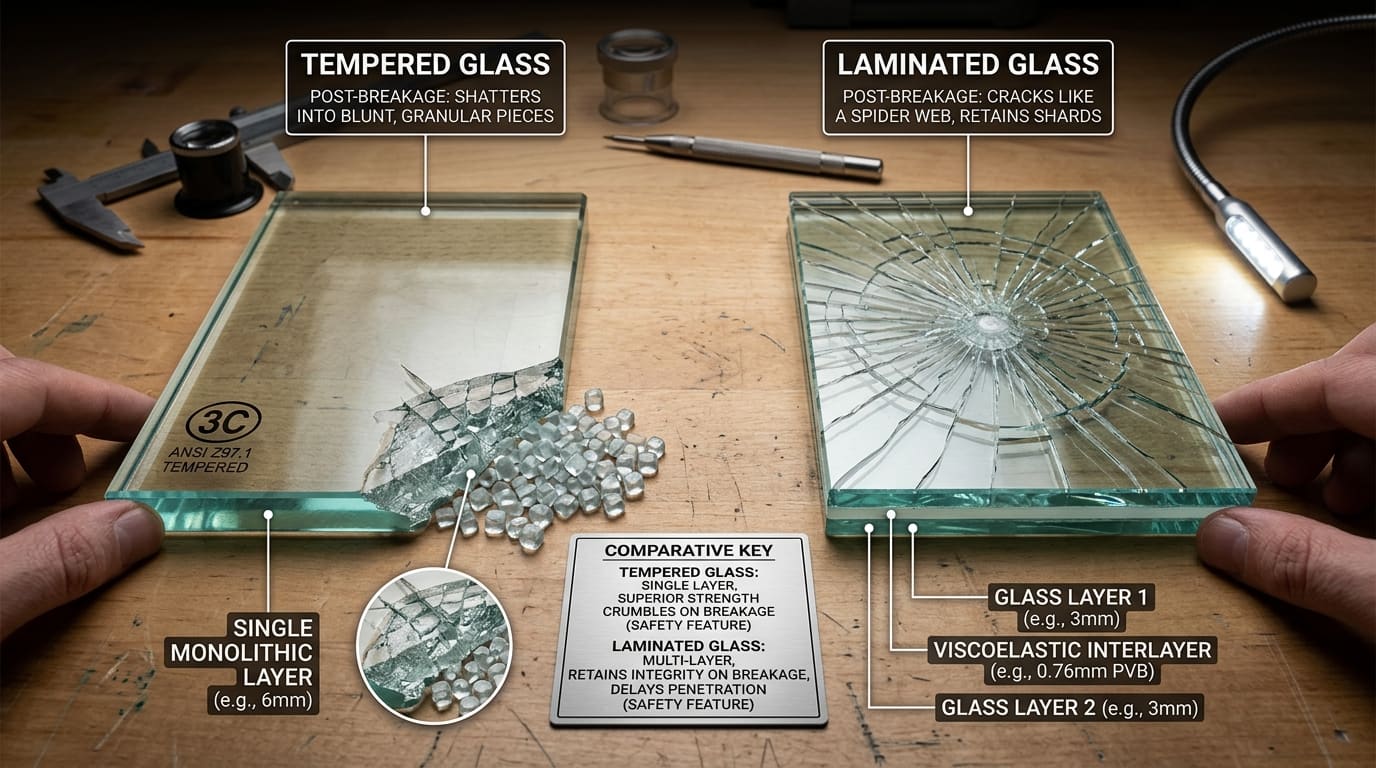
All shower and tub enclosure glass must be tempered safety glass under both IRC building code and ANSI Z97.1 standards. This is not optional — it is the law, and for good reason. Annealed glass (regular glass) shatters into large, knife-like shards when broken. Tempered glass, when it does break, shatters into small, relatively blunt pebbles that are far less likely to cause serious lacerations. In an environment where a fall might bring a person into contact with the glass while going down, this difference is literally life or death.
For aging-in-place applications, we typically recommend 3/8-inch or 1/2-inch tempered glass for shower enclosures rather than the minimum 3/16-inch that some codes permit. Thicker glass is more rigid and less likely to flex under load — a consideration if someone needs to use the glass panel as a stabilizing surface during entry or exit. Frameless 1/2-inch glass panels have a substantial, solid feel that instills confidence. We have found that this psychological solidity matters to seniors and their families.
Laminated glass is an option for shower applications where the consequences of breakage are a particular concern. Unlike tempered glass, which shatters completely on impact even if no one is hurt, laminated glass holds together even when broken. If a shower glass panel is broken by a fall, a laminated panel stays in the frame as a cohesive (though cracked) unit rather than producing a pile of glass cubes on the shower floor that themselves become a hazard. Laminated shower glass is a premium option that we recommend for clients with specific safety concerns.
Grab Bar Integration with Glass Shower Systems
One of the most common requests we handle in aging-in-place shower work is integrating grab bars with frameless glass shower systems. Standard grab bars are mounted to wall studs or blocking behind the tile — they are anchored to the structure, not to the glass. However, the grab bar placement often intersects with glass panel placement in ways that require coordination between the glass fabrication and the grab bar installation.
Some clients ask about glass-mounted grab bars — hardware that attaches to the frameless glass panel itself. We are cautious about these for aging-in-place applications. Glass-mounted hardware relies on the glass panel and its mounting hardware to carry the full load of a person grabbing and stabilizing against a fall. The engineering can be done adequately for light-duty use, but for a scenario where a senior is catching themselves during a fall, we prefer grab bars anchored to wall structure. The glass should be a surface, not a structural support.
The design challenge is creating a frameless shower system where the glass positions work harmoniously with proper wall-mounted grab bar placement. Virginia Glass Windows collaborates with remodelers, occupational therapists, and certified aging-in-place specialists (CAPS) who are increasingly common in the DMV market. We bring the glass specification to the broader accessibility design conversation rather than treating it as an isolated trade decision. If you are working with an OT or CAPS specialist, we are happy to coordinate directly with them to ensure the glass installation supports rather than compromises the overall safety design.
Glass Shelves, Mirrors, and Other Interior Glass Hazards
Bathroom glass hazards extend beyond the shower enclosure. Frameless glass shelves, mirrored medicine cabinet doors, and large decorative mirrors are all potential injury sources in a bathroom used by seniors. Glass shelves should be tempered — not the annealed glass that lower-cost bathroom shelving uses. Mirrored cabinet doors should have backing and mounting hardware that prevents the mirror from falling forward if the hinge loosens. Standalone or wall-leaning mirrors in bedrooms and bathrooms should be properly anchored to wall studs.
Glass bathroom shelves for aging-in-place applications should be specified with a minimum of 3/8-inch tempered glass, proper bracket spacing to prevent flex under load, and edge finishes that do not create sharp edges if accidentally contacted. We replace a fair number of frameless glass shelves in DMV bathrooms that were installed with 1/4-inch annealed glass — the kind that will shatter badly if bumped hard or if something heavy falls on it. The cost difference between annealed and tempered glass shelving is minor; the safety difference is enormous.
Sliding glass closet doors and mirrored wardrobe doors in bedrooms deserve mention. These are in the hazardous locations category under building codes when the bottom edge is within 18 inches of the floor, but older homes were built before current safety glazing codes and may have annealed mirror glass in these positions. Virginia Glass Windows can assess the safety glazing status of glass in your home and recommend replacements where current code would require safety glass. For an aging-in-place retrofit, this assessment is worth doing throughout the home.
Door Glass and Sidelight Safety
Entry door glass, sidelight panels, and full-lite storm doors are all hazardous locations that require safety glazing under building codes. For an aging-in-place home, ensuring all door glass is properly safety-glazed is a basic but important step. Older homes in DC's residential neighborhoods — Capitol Hill, Petworth, Brookland, and similar areas with dense older housing stock — frequently have annealed glass in door sidelights that was installed decades before current safety codes.
For seniors who may become disoriented, particularly those with dementia or low vision, large glass door panels can be a fall hazard if the glass is not clearly visible. Decorative etching, sandblasting, or applied film can make large glass panels more visually apparent without significantly reducing light transmission. Some families also add visual markers — horizontal frosted bands at eye level — to make glass surfaces visible to family members with dementia who might walk into a glass panel that reads as an open doorway.
Virginia Glass Windows conducts free home safety glass assessments for aging-in-place projects. We walk through the home, identify all glass in hazardous locations, assess whether current safety glazing codes are met, and provide recommendations for the modifications that will have the greatest safety impact. This is a service we offer because we believe the assessment itself adds value regardless of whether it leads to glass work. Call (703) 470-7867 to schedule a free aging-in-place glass safety assessment.
Need Help With Your Glass?
Send us a photo of your window or glass issue and get a free estimate within hours. Our experts serve all of DC, Maryland, and Virginia.
Common Questions
Frequently Asked Questions
Answers to common questions about this topic from our DMV glass experts.
Keep Reading
Related Guides
Explore More Resources
Related Articles
Common Problems
Related Pages
Our Services
Ready to Get Started?
Get a free estimate from our glass experts. Same-day service available across DC, MD & VA.