Vinyl Frames
Welded multi-chamber uPVC. The hollow cells do the insulating, so the whole-frame number is good without a thermal break, and there is nothing to paint. The standard replacement frame across most of the DMV housing stock.

New sealed units into existing sash, and new windows into the opening. We template rather than estimate, specify the glass make-up against the wall it is going into, and install to the detail that keeps water out — sill pan, lapped flashing, shims at the load points, low-expansion foam. Residential and commercial across DC, Maryland and Virginia.
Bonded & Insured
Residential and commercial
24/7 Emergency
Seven days a week
Free Estimates
No obligation
Locally Owned
Residential and commercial
Upfront Pricing
Never an overtime charge
Templated
To your exact opening
DC/MD/VA
All three jurisdictions
Tempered
Safety glazing to code
Same-Day
Service available
Each of these is a different assembly with its own hardware, tolerances and code path. Drawings, not stock photos.
Welded multi-chamber uPVC. The hollow cells do the insulating, so the whole-frame number is good without a thermal break, and there is nothing to paint. The standard replacement frame across most of the DMV housing stock.
Strong, slim sightlines, and the frame of choice on commercial openings. Anything current carries a polyamide thermal break between the inner and outer shells — without it the frame conducts straight through and sweats.
Solid wood inside for the interior you want, with an extruded aluminium or fibreglass skin outside so nothing needs painting. Usually the right answer in Old Town, Georgetown and Capitol Hill where a review board is involved.
Pultruded glass fibre expands and contracts at close to the same rate as the glass it holds, so the seal is worked far less over a DMV year. Narrow sightlines with the stiffness to carry a large unit.
A new frame set inside the existing one. Fast, no disturbance to trim or siding, and the right call when the old frame and sill are sound. You give up an inch or so of glass in each direction.
Sealed units made to your template: 3 mm or thicker lites, a warm-edge spacer, argon in the cavity and Low-E on surface 2. Laminated, obscure, tempered and grid-between-glass build-ups all available.
Delaying repair doesn't save money — it multiplies the damage.
Openings are rarely square and almost never the same width top and bottom. A unit ordered from one measurement, or from the largest of three, does not go in — and a tempered or sealed unit cannot be trimmed to fit on site. It goes back to the fabricator and the opening stays boarded while a second one is made.
In a mixed-humid climate like the DMV the coating belongs on surface 2, the cavity face of the outboard lite. Put it on surface 3 and you change what the unit does with solar gain and how it behaves in a cold snap. It is not visible from the room, which is exactly why it has to be specified rather than assumed.
Most leaks blamed on a window are installation, not product. No sill pan, flashing lapped the wrong way, a bead of sealant asked to do a flashing job, or fasteners driven through shims. The window is fine; the wall behind it is not, and it takes a season or two to show.
High-expansion foam in the shim gap will bow a jamb enough to stop a sash from running. So will fastening through a shim, or shimming anywhere other than the load points. The window operated perfectly at 10 a.m. and does not at 4 p.m., and by then it is behind casing.
Don't let it get worse
Every service comes with our commitment to quality, speed, and transparency.
Three widths, three heights, both diagonals, and a physical template for anything shaped or out of square. The order is only as good as the measurement it came from.
Orientation, noise, whether it is a hazardous location, and what you are trying to fix. We give you the U-factor, SHGC, VT and the sound ratings for each option instead of a brochure adjective.
Which one applies is decided by the condition of the existing frame and sill. We tell you what we find and why, including when an insert is the better job.
Sill pan first, flashing lapped shingle-fashion, backer rod behind the exterior joint. Sealant is the last line of defence, not the first.
Doors, sidelites, low sills, wet areas, stairs and guards get tempered or laminated glass with the permanent etched mark, per IRC R308 and IBC 2406 as adopted in your jurisdiction.
Sash, units, glazing compound and debris hauled away, floors covered while we work, and the glass cleaned before we go.
Every window installation job starts with the assembly, not the pane. What the frame is, how the glass is captured, which code applies to that opening — those decide the specification, and the specification decides whether the repair lasts.
Upload photos of the glass and we will come back with an itemized estimate. No home visit needed, no obligation.
Upload Photos NowA simple, transparent process from first contact to completed job.
Send pictures of the window inside and out with a rough size, or we come and look. Either way you get a specification before anything is ordered.
Three widths, three heights, both diagonals, and the bite where glass is going back into existing sash. Shaped and arched openings get a physical template.
Make-up, coating, gas fill, spacer, safety glazing where the code requires it, frame material and finish. Every decision is fixed at this point because sealed units are made to order.
The unit is built to the template. We give you the fabricator lead time when the order goes in and schedule the install around it.
Protect, remove, dry-fit, pan and flash, set and shim, operate, insulate, seal, trim and clean. You keep the specification sheet.
Before
Damaged, inefficient glass compromising safety and comfort.
After
Crystal-clear, professionally installed glass restoring beauty and performance.
These are two different jobs and the right one depends on what has actually failed. If the frame is sound, the sash runs, and only the glass is broken or the sealed unit has fogged, the glass is what gets replaced — the unit is made to the template and set back into the existing sash, which is faster and leaves your trim untouched. If the frame is rotten, the sash no longer meets the frame, or the window is a single-glazed original you want brought up to current performance, then the window itself is replaced. We will tell you which one your opening is, including the cases where the smaller job is the right one.
Width is taken at the head, the middle and the sill; height at each jamb and up the centre. The smallest of each governs, because a unit made to the largest simply will not go in. Both diagonals are measured to check the opening is square: if they differ, the opening is racked and the new frame is shimmed square rather than following the old one. For glass going back into an existing sash we measure the daylight opening and add the bite on each side — the amount the bead or stop actually holds. Anything arched, angled or with a hole in it gets a physical template. Tempered glass cannot be trimmed on site, so the template is the job.
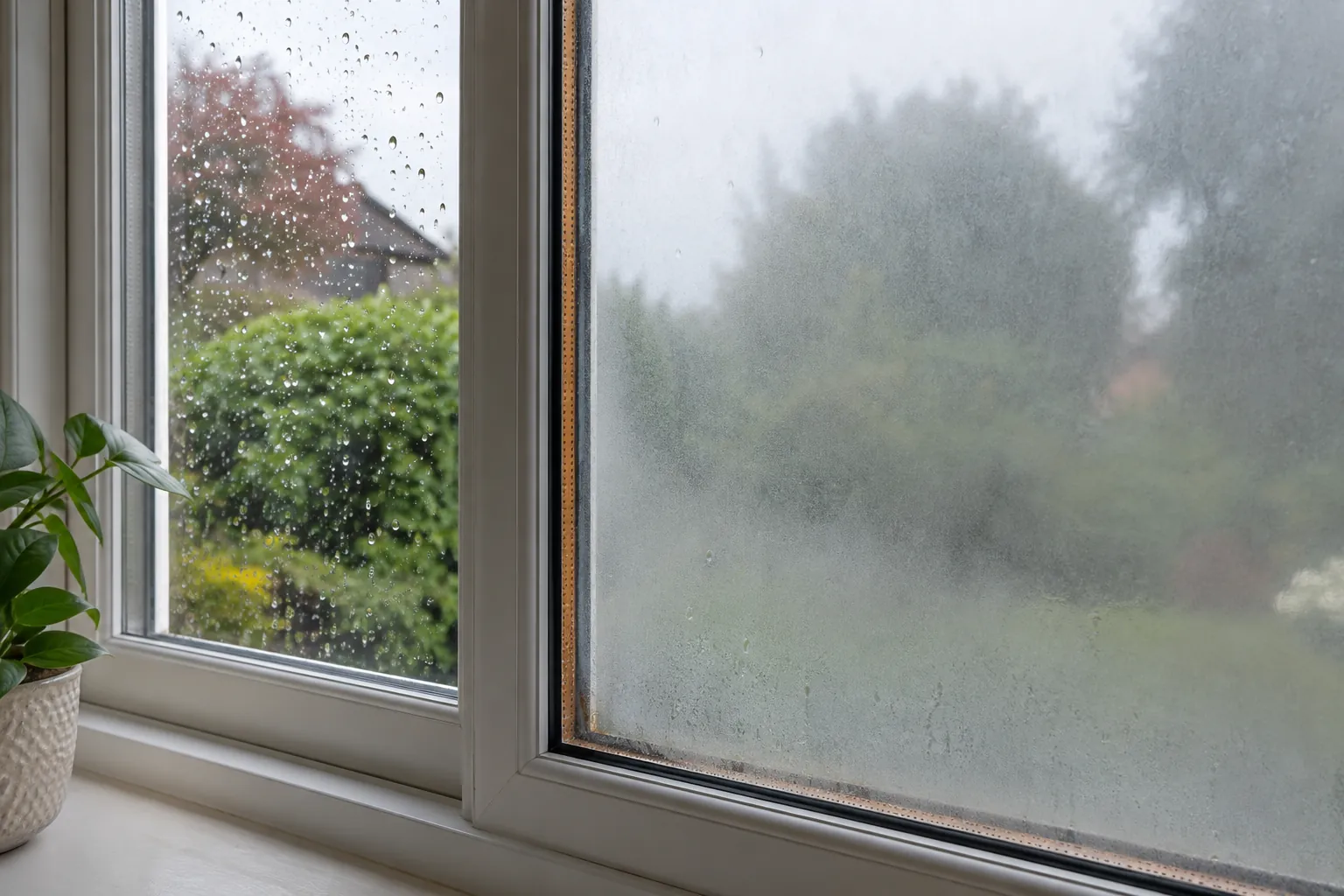
An insulated glass unit is two or three lites separated by a spacer bar and sealed at the edge. The spacer is filled with desiccant to absorb whatever moisture is trapped when the unit is built. A primary polyisobutylene seal between the spacer and each pane is the vapour barrier; a secondary structural seal fills the channel behind it and holds the sandwich together. The cavity is usually filled with argon, which is denser and less conductive than air. Warm-edge spacers replace the traditional aluminium bar with a low-conductivity section, which raises the temperature at the sightline and is the main reason a modern unit does not run with condensation along its bottom edge in January.
The four glass faces in a double-glazed unit are numbered from the outside in: surface 1 faces the weather, surfaces 2 and 3 face the sealed cavity, and surface 4 faces the room. A low-emissivity coating is a microscopically thin metallic layer that passes short-wave daylight and reflects long-wave heat. In the mixed-humid climate the DMV sits in, that coating goes on surface 2, where it turns summer solar heat back outside before the cavity picks it up and still reflects room heat back inside in winter. Sealed inside the cavity it cannot be scratched, cleaned off or degraded. The performance difference is not subtle: in the numbers we publish, going from an uncoated double unit to a Low-E argon unit takes the centre-of-glass U-factor from 0.48 down to 0.27 and cuts solar heat gain by half.
Vinyl is welded uPVC with hollow chambers doing the insulating; it performs well, needs no painting, and is what most DMV replacement work uses. Aluminium is strong with slim sightlines and dominates commercial openings, but it must have a polyamide thermal break or the frame conducts straight through and sweats in winter. Clad wood gives a real wood interior with a maintenance-free exterior skin, and is usually what a historic review board will accept in Georgetown, Old Town Alexandria or Capitol Hill. Fibreglass is pultruded glass fibre that expands and contracts at close to the same rate as glass, so the sealed unit is worked far less through a DMV year of 95 degree Julys and 20 degree Januarys.
An insert, sometimes called a pocket replacement, sets a new frame inside the existing one. The exterior trim and siding are never disturbed, the job is quick, and the interior casing usually survives. The trade is that you lose roughly an inch of glass in each direction and you inherit whatever the old frame and sill are doing. A full-frame replacement removes everything back to the rough opening. It costs a day rather than an afternoon and it disturbs the exterior, but it is the only way to install a sill pan, lap the flashing correctly, insulate the shim gap and deal with rot you cannot see from inside. Neither is the default; the condition of the existing frame decides.
Almost every leak blamed on a window is an installation detail rather than a product fault. The sill pan goes in before the window and turns up at the back and the ends. Flashing laps shingle-fashion: sill first, jambs over the sill, head over the jambs, so gravity carries water out rather than in. Shims go at the load points and fasteners go through the frame into structure, never through a shim. The shim gap is filled with low-expansion foam only — the high-expansion kind will bow a jamb far enough to stop a sash from running. The exterior joint is backed with rod and sealed with a product suited to the substrate. Sealant is the last line of defence, not the first.

Professional service for homes, condos, and townhomes across the DMV.

Serving offices, retail, restaurants, and buildings of any scale.
If the frame is sound and the sash still runs, and the problem is broken glass or a fogged sealed unit, the glass is what gets replaced. A new unit is made to the template and set back into the existing sash, which is quicker and leaves your trim and siding untouched. You need the window itself replaced when the frame is rotten, the sash no longer meets the frame, the hardware is obsolete, or you are moving a single-glazed original up to current performance. We tell you which one you are looking at after we have seen the opening, including the times the smaller job is the right one.
Work we stand behind
Virginia Glass Windows is locally owned and has been doing residential and commercial glass across Northern Virginia, DC and Maryland for over a decade. Bonded and insured, on call around the clock.
An insulated glass unit is two lites, a cavity, and a seal that has to hold for decades. Almost all of the performance you pay for comes from a coating a few atoms thick on one particular face — and which face it is on is not a detail.
The four glass faces are numbered from outside in. Surface 2 is the cavity side of the outboard lite, and that is where the Low-E coating goes in this climate: it lets short-wave daylight through and turns back the long-wave heat, out in summer and back into the room in winter. Sealed inside the cavity, nothing can scratch or clean it off.
The unit lives or dies at its edge. Primary polyisobutylene against each pane is the vapour barrier; the secondary seal is what holds the sandwich together; the desiccant in the spacer takes up whatever moisture is trapped at build. Warm-edge spacers replace the aluminium bar with a low-conductivity section, which is where the condensation resistance at the sightline comes from.
| Glazing | U-factor | SHGC | VT | STC | OITC | Where it shows up |
|---|---|---|---|---|---|---|
| Single pane, clear | 1.04 | 0.79 | 0.88 | 28 | 23 | Pre-1980 homes and historic sash |
| Double pane, clear (no coating) | 0.48 | 0.70 | 0.79 | 29 | 24 | 1980s-1990s builder grade |
| Double pane, Low-E | 0.30 | 0.38 | 0.70 | 30 | 25 | Current code minimum, DMV |
| Double pane, Low-E with argon | 0.27 | 0.35 | 0.68 | 31 | 26 | ENERGY STAR Northern-Central |
| Laminated insulated glass | 0.28 | 0.33 | 0.66 | 38 | 32 | Noise, security and UV upgrade |
| Triple pane, Low-E with argon | 0.18 | 0.28 | 0.60 | 36 | 30 | Premium performance retrofit |
Lower U-factor is less heat lost. Lower SHGC is less solar heat gained. VT is how much visible light comes through. STC and OITC are sound ratings, and OITC is the honest one for traffic and aircraft because it weights the low frequencies. Centre-of-glass values — the whole-window number is always a little worse because of the frame and the sightline.
Six measurements and two diagonals. The opening in this drawing is deliberately out of square, because most of them are.
Width gets taken three times — at the head, at the middle and at the sill — and height three times, at each jamb and up the centre. The smallest of each governs, because a unit ordered to the largest will not go in. Then both diagonals: if they do not match, the opening is racked and the frame has to be shimmed square rather than followed.
For glass going back into an existing sash we measure the daylight opening and add the bite on each side — the amount the stop or the bead holds. Get that wrong in one direction and the lite rattles; wrong in the other and it will not seat, and with tempered glass there is no trimming it on site.
Anything shaped, out of square or with a hole in it gets a physical template rather than a dimension sheet. Arched heads, angled tops in a gable, and hardware cut-outs are all cheaper to template once than to order twice.
Weight is part of the plan. A 36 by 60 inch sealed unit in 1/4 inch glass runs about 97 lb before the frame. That is a 2-person set with two-cup carriers — two-person carry. awkward, not heavy.
The frame decides the whole-window U-factor, how the unit is captured, and how much of the wall you get to keep. Four sections, drawn at the same scale.
Multi-chamber uPVC. The hollow cells are the insulation, welded corners are the structure.
Two shells with a polyamide thermal break between them. Without the break the frame conducts straight through.
Solid wood inside for the look, an extruded aluminium or fibreglass skin outside so nothing needs painting.
Pultruded glass fibre. It expands and contracts at close to the same rate as the glass it holds, so the seal is not worked as hard.
An insert keeps the existing frame and trim, so the job is faster and the exterior is undisturbed — but you lose an inch or so of glass in each direction and you inherit whatever the old frame and sill are doing. A full-frame replacement goes back to the rough opening, which is the only way to install a sill pan, lap the flashing correctly and fix rot you cannot see from inside.
Floors covered, the room masked, the old sash or unit removed whole where it can be, cut out where it cannot. Old glazing compound and putty come off cleanly rather than being buried.
The new unit is offered up before any sealant. Racked openings, rotten sills and out-of-plane jambs are found now, not after the foam has gone in.
On a full-frame install, the pan goes in before the window and the flashing laps shingle-fashion — bottom over the wall, sides over the bottom, head over the sides. Water that gets in has to get back out.
Shims go at the load points, the frame is checked plumb, level and square on the diagonals, and the fasteners go through the jamb into framing — never through a shim that is doing structural work.
Sash raised, lowered, locked and tilted while it can still be adjusted. A window that binds after the trim is on gets fixed twice.
Low-expansion foam only. The high-expansion kind bows a jamb enough to stop the sash. Exterior joint on backer rod with the right sealant for the substrate.
Interior stops and casing, exterior trim, glass cleaned, debris and old glass hauled away, and the specification left with you for your records.
None of this is complicated, and all of it saves time on the day. Sealed units are made to order, so the decisions in the second row want to be settled before the order goes in.
Furniture, blinds and window treatments moved back from the opening before the crew arrives. We can do it, but it is time on the clock and things get broken that would not have been.
Clear or obscure, Low-E or not, grids or none, tempered where the code calls for it. Once the unit is ordered these are fixed, because sealed units are made to order.
Sheets of glass are carried, not wheeled. In DC and Arlington a permitted space or a driveway makes a real difference to how the day goes.
Georgetown, Old Town, Capitol Hill and many DMV associations review anything visible from the street. Approval belongs to the owner and it wants to be in hand before we order.
Broken glass is being removed. The room is a work area until it is cleaned up and vacuumed.
Exterior sealant, flashing and glazing beads are worked from outside. Locked gates, dogs in the yard and blocked side returns are the usual surprises.
| Thickness | Metric | Per sq ft | Practical span |
|---|---|---|---|
| 1/8 inch | 3 mm | 1.62 lb | 24 in |
| 3/16 inch | 5 mm | 2.43 lb | 36 in |
| 1/4 inch | 6 mm | 3.25 lb | 48 in |
| 3/8 inch | 10 mm | 4.87 lb | 78 in |
Virginia Uniform Statewide Building Code (2021 IRC/IBC with amendments)
VA enforces the USBC statewide, so Arlington, Fairfax and Loudoun read from the same book. Local plan review still varies.
Maryland Building Performance Standards (2021 IBC/IRC) plus county amendments
Montgomery and Prince George’s counties add amendments. Montgomery is the stricter of the two on guard glazing.
DC Construction Codes (2017 base, 2021 update cycle) with DC supplements
DC adds historic-district review on any street-facing change. Expect DCRA review time on storefront work.
Photos of the window inside and out, plus a rough width and height, are enough to start. DC, Northern Virginia and the Maryland suburbs.
Upload photos for a free estimate, or call for same-day service. Bonded and insured across DC, Maryland and Virginia.