Residential service 24/7 Emergency

Entry Door Glass & Glass Front Doorsin DC, MD & VA

Front entries are a door, a sidelite or two and often a transom, and the building code treats each of them differently. We replace decorative inserts, clear and obscure sidelites, transom lites and full-lite glass front doors — tempered or laminated, specified to the hazardous location rules that apply to your opening, and templated on site rather than ordered off a size chart.

  • 24/7 Emergency Service
  • DC · Maryland · Virginia
  • Free photo estimates

Bonded & Insured

Residential and commercial

24/7 Emergency

Seven days a week

Free Estimates

No obligation

Locally Owned

Residential and commercial

Upfront Pricing

Never an overtime charge

24/7

Emergency dispatch

DC/MD/VA

All three jurisdictions

Laminated

Safety glazing to code

Same-Day

Service available

Types we handle

Entry Door Glass: what we work on

Each of these is a different assembly with its own hardware, tolerances and code path. Drawings, not stock photos.

Entry door with sidelites and transom, elevationA half-lite entry leaf between two narrow sidelites, under a transom, all glazed with safety glass.

Decorative Door Inserts

The came-and-bevel panel in the middle of a front door is not one sheet of leaded glass. It is a sealed sandwich: a tempered lite outboard, the decorative panel, a tempered lite inboard, clamped by two retainer frames screwed through the door skin. Which is why it can fog, and why the whole insert comes out as an assembly.

Entry sidelite, elevationA half-lite entry leaf between two narrow sidelites, under a transom, all glazed with safety glass.

Sidelites

The narrow lites flanking the door. Their vertical edge is almost always inside the twenty-four inch arc from the door edge with the bottom edge well under sixty inches, so they are a hazardous location and require safety glazing. Available clear, obscure, reeded, or matched to the came pattern in the door.

Transom lite over a door head, elevationVision glass above an intermediate rail with a solid bulkhead panel below, in the same aluminium perimeter frame.

Transoms

The lite over the head, rectangular, arched or elliptical. Where the bottom exposed edge is sixty inches or more above the floor it falls outside the adjacent-to-door rule, but it is still glass over an entry and it is usually specified tempered anyway. Arched transoms are templated, never measured off a drawing.

Half-lite storefront, elevationVision glass above an intermediate rail with a solid bulkhead panel below, in the same aluminium perimeter frame.

Full-Lite Glass Front Doors

A single large lite filling the leaf, in wood, fibreglass, steel or aluminium. All of it is glazing in a swinging door, so all of it is safety glazing. The larger the lite, the more the make-up matters: Low-E position, argon, and whether laminated is the better answer than tempered.

Storm door over an entry leaf, elevationA half-lite entry leaf between two narrow sidelites, under a transom, all glazed with safety glass.

Storm and Screen Door Glass

Full-view and half-lite storm panels, interchangeable glass and screen inserts, and the corner keys and gaskets that hold them. Storm door glass takes more thermal cycling than any other glass on the house, because the air trapped behind it gets very hot.

Failed sealed unit, section through the edgeA breach in the perimeter seal lets the gas fill escape and moist air in. Once the desiccant saturates, that moisture condenses on the cavity faces and the unit fogs.FOGGINGBREACH

Fogged Inserts and Sidelites

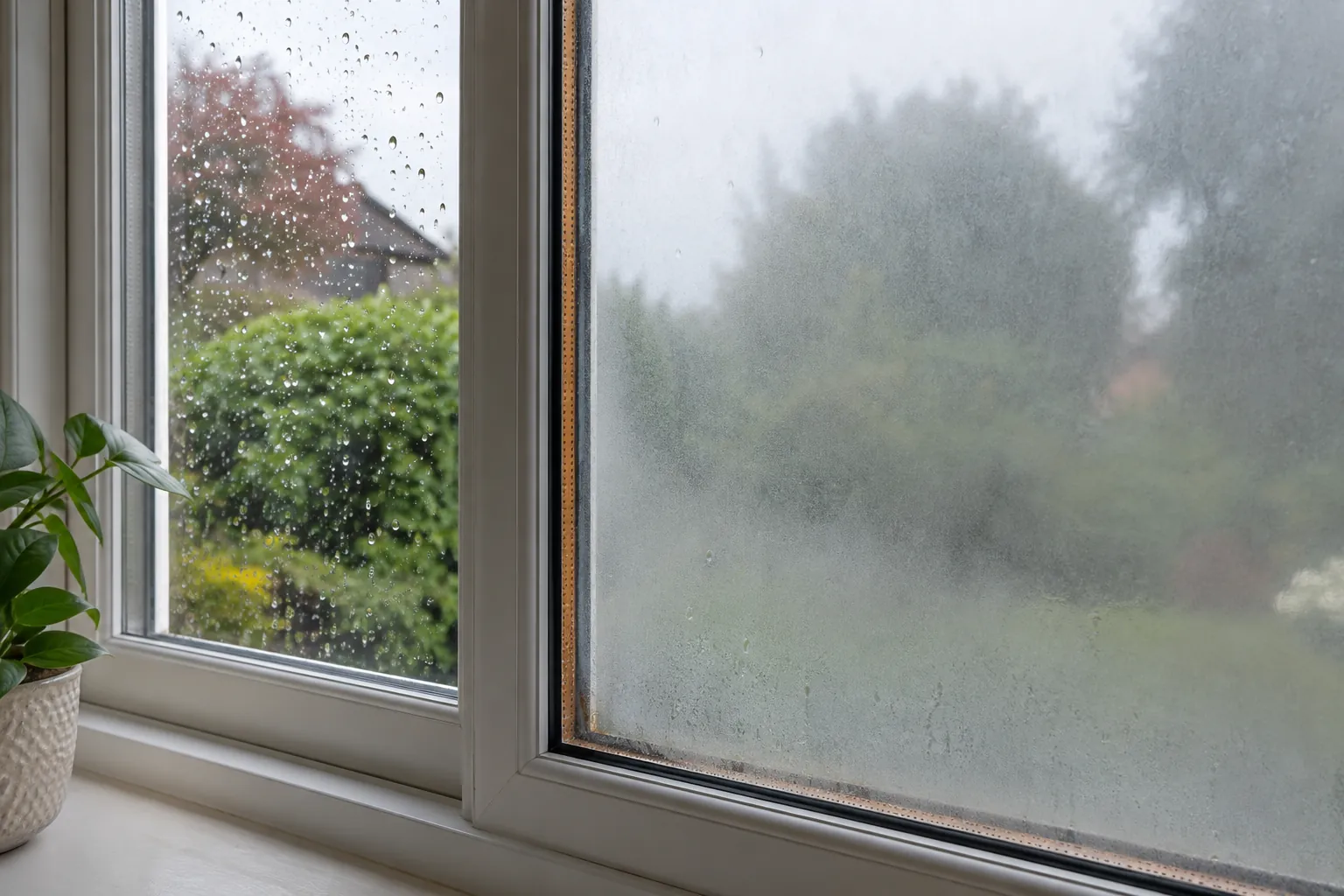
Haze, streaking or a tidemark between the panes means the perimeter seal has failed and the airspace is breathing. It is not cleanable, and the mineral staining etches the inner surfaces permanently. The sealed unit is replaced and the frame, hardware and door stay put.

Every hour costs you more

Why you need entry door glass now

Delaying repair doesn't save money — it multiplies the damage.

01

A Broken Front Door Lite Is an Unlocked Door

Glass in or beside a front door sits at arm's length from the thumbturn. Once a sidelite or an insert is broken, the deadbolt is decorative. This is the one glass failure where the opening has to be closed before anything else happens.

02

The Wrong Glass Fails the Next Inspection

Glazing in a door is a hazardous location under IRC R308.4.1, and glazing beside it is caught by R308.4.2. Both require labelled safety glazing. Annealed glass put back into a sidelite is a defect a home inspector will write up and an insurer may take an interest in.

03

A Fogged Insert Is Read as Neglect

The front door is the one elevation everybody looks at. A hazed or tidemarked insert reads as a house that is not being kept up, and it will not clean off — the staining is on the inside faces of a sealed unit.

04

Heat and Draught Through the Entry

An entry is a lot of glass in a small area, and a failed unit has lost its argon and its coating performance. Cold radiating off the sidelites in January and a hot patch of floor inside the door in July are both the same failure.

What You Get

Entry Door Glass Benefits

Every service comes with our commitment to quality, speed, and transparency.

01

Insert, Sidelite and Transom All Handled

One crew for the whole entry, so the insert, the sidelites and the transom match each other when the job is done.

02

Specified to the Right Rule

We identify which hazardous location provision applies to each lite in your opening and specify labelled tempered or laminated glazing accordingly.

03

Laminated Where It Earns Its Place

On ground-floor entries and doors that have already been forced, laminated glass keeps the fragments on the interlayer and the sheet in the frame.

04

Board-Up the Same Visit

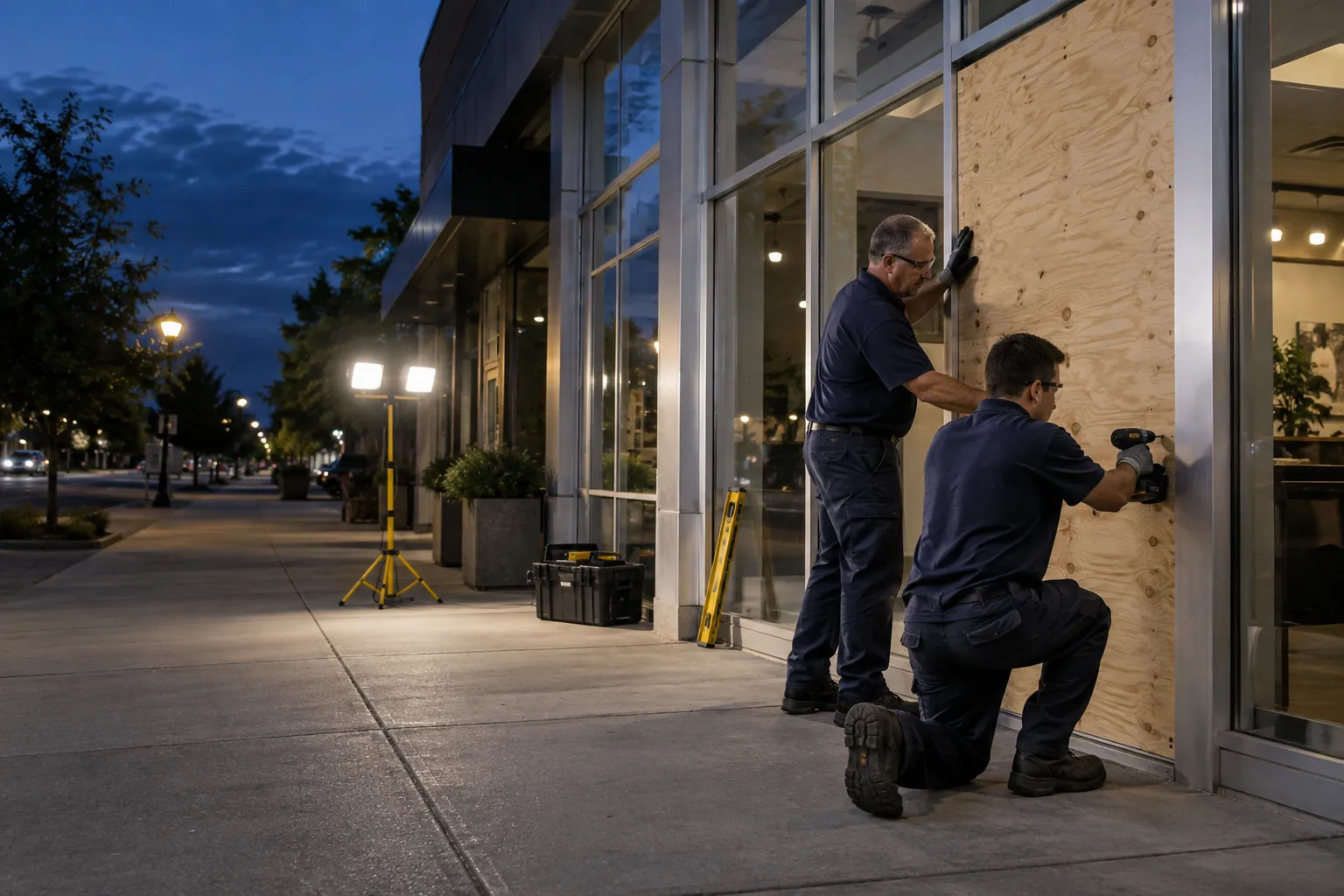
When the opening cannot be glazed immediately it gets secured immediately. The house is closed before we leave.

05

Arched and Elliptical Work Templated

Radius transoms and shaped sidelites are templated on site from the actual opening, not scaled off a catalogue drawing.

06

Obscure and Privacy Options

Reeded, satin-etched, glue-chip and patterned obscure glazing for sidelites where the entry looks straight into a hallway.

Entry Door Glass on a job site in the DMV
Insulated glass unit, section through the edgeTwo lites of glass separated by an argon-filled cavity. The low-emissivity coating sits on surface two, the room side of the outboard lite. A warm-edge spacer holding desiccant is bedded on a primary seal, with a secondary seal closing the edge.1234EXTERIORINTERIORLOW-E COATING — SURFACE 2ARGON-FILLED CAVITYWARM-EDGE SPACER + DESICCANTSECONDARY SEAL
Sealed unit — edge section
The detail behind it

Specified before it is ordered

Every entry door glass job starts with the assembly, not the pane. What the frame is, how the glass is captured, which code applies to that opening — those decide the specification, and the specification decides whether the repair lasts.

  • Safety glazing specified to the code for the opening
  • Same-day service for most jobs
  • Free photo estimates with no obligation
  • Bonded and insured, residential and commercial

Get a Free Entry Door Glass Estimate

Upload photos of the glass and we will come back with an itemized estimate. No home visit needed, no obligation.

Upload Photos Now
Our Process

How Entry Door Glass Works

A simple, transparent process from first contact to completed job.

01

Photograph the Whole Opening

One shot square on from outside showing door, sidelites and transom together, plus a close-up of the damage. That pair identifies most entries.

02

Secure It

Broken glazing in or beside a front door is boarded or filmed on the first visit. Security first, appearance second.

03

Template and Specify

We measure each lite at the opening, identify which hazardous location rule catches it, and specify tempered or laminated, single lite or sealed unit, with the Low-E and gas fill recorded.

04

Glaze or Swap the Insert

Sidelites and transoms are re-glazed in their frames. Decorative inserts come out as an assembly, the new one goes in, and the retainer frames are re-screwed and sealed.

05

Check the Entry Closes

Weatherstrip, sweep, latch engagement and deadbolt throw are checked before we leave, because an entry that does not shut properly loads the glass.

The Transformation

Before & After Entry Door Glass

Before

Damaged, inefficient glass compromising safety and comfort.

After

Crystal-clear, professionally installed glass restoring beauty and performance.

Warning Signs

Signs You Need Entry Door Glass

A cracked or shattered sidelite next to the front door.
Haze, streaking or a tidemark inside a decorative insert that will not clean off.
Came or lead in the insert that has darkened, lifted or gone loose.
Condensation forming on the inside of the glass on cold mornings.
A cold band you can feel standing in front of the sidelites in winter.
Retainer frame screws that have backed out, or a frame standing proud of the door skin.
A transom that has dropped in its opening or shows an open joint at the head.
Storm door glass that has cracked more than once in the same panel.
A hot patch on the hall floor inside the door on summer afternoons.
Glazing next to the door with no permanent safety label etched in a corner.

Two Different Rules Catch an Entry, and They Catch It Differently

IRC R308.4.1 and IBC 2406.4.1 make glazing in all fixed and operable panels of swinging, sliding and bifold doors a hazardous location. That is the door itself, and no measurement is involved: apart from two narrow written exceptions — openings too small to pass a three-inch sphere, and decorative glazing — glass in a door is safety glazing. R308.4.2 and IBC 2406.4.2 then catch glazing next to the door: where the nearest vertical edge falls within a twenty-four inch arc of either vertical edge of the door in its closed position, and the bottom exposed edge is less than sixty inches above the floor. That arc is swung in plan, which is why a window in a return wall beside the entry can be caught by it even though it looks nowhere near the door in elevation. A transom whose bottom edge sits sixty inches or more above the floor falls outside that particular provision. Virginia enforces these through the Uniform Statewide Building Code, Maryland through the Maryland Building Performance Standards, and the District through the DC Construction Codes.


What Is Actually Inside a Decorative Insert

The leaded or wrought-iron panel in the middle of a front door is never exposed to weather. It sits between two lites of tempered glass, and the three of them are clamped together by a two-piece retainer frame that screws through the door skin from the inside. The perimeter of that sandwich is sealed, which means a decorative insert behaves like a sealed window unit: when the seal fails, the airspace starts breathing, moisture condenses on the inner faces and the came stains. That is not cleanable and there is no way to open the sandwich without destroying the panel. The replacement is the whole insert assembly, sized to the cut-out in the door and matched to the came pattern, the bevel layout and the finish of what you have.

Tempered or Laminated on a Front Door

Both are safety glazing and both satisfy the code, but they fail in opposite ways. Tempered glass is heat-treated so the surfaces are in compression; when it breaks it dices into small granular pieces and the opening is empty a second later. Laminated glass is two lites bonded to a plastic interlayer, typically thirty thousandths of an inch on a residential door; when it breaks the fragments stay stuck to the interlayer and the sheet stays in the frame. On a rear or side entry, or a door that has been forced before, that difference is the whole argument for laminated — it turns a quiet, quick entry into a loud, slow one. Laminated also cuts road noise noticeably and blocks essentially all ultraviolet, which matters for hallway flooring and furniture directly inside the door.

Low-E, Argon and Surface #2

Where an entry lite is an insulating unit, it is two lites separated by a spacer and sealed at the perimeter, and the surfaces are numbered from the outside in: #1 is the outdoor face of the outer lite, #2 its indoor face, #3 and #4 the two faces of the inner lite. A low solar gain Low-E coating normally sits on surface #2, where it reflects solar infrared back out before it reaches the airspace. That is the right position for the mixed heating and cooling climate the DMV sits in, and it is why a west-facing entry with an original single-glazed sidelite feels so different from one with a modern unit. Argon in the airspace lowers conduction and a warm-edge spacer keeps the perimeter from driving condensation at the bottom corners.

Sidelites, Privacy and Obscure Glazing

A clear sidelite gives whoever is at the door a straight view down your hallway. Obscure glazing solves that without losing daylight: satin acid-etched glass gives an even, soft diffusion; reeded and fluted glass distorts vertically and is having a long moment in DMV renovations; glue-chip has a frost-fern pattern that suits older houses; and patterned rolled glass covers everything in between. All of it can be made as safety glazing, which it has to be in a sidelite. Where the existing sidelite has a came pattern that matches the door insert, we match the pattern rather than substituting a plain obscure lite, because a mismatched pair reads immediately from the kerb.

Storm Doors and the Panel Behind Them

A storm door traps a layer of air against the entry door, and on a south or west elevation that air gets very hot. That is why storm door glass sees more thermal cycling than anything else on the house, and why a dark entry door behind a full-view storm door is a known combination for heat build-up. We replace full-view and half-lite storm panels, the interchangeable glass and screen inserts, the corner keys and the gaskets that hold them. If your storm door glass has broken more than once, the answer is usually ventilation and colour rather than a stronger pane, and we will say so.

Historic Districts and Original Entry Glass

Georgetown, Capitol Hill, Old Town Alexandria and the historic districts in Montgomery and Arlington counties review exterior changes visible from the public way, and a front entry is the most visible thing on a house. Original transom lites, leaded sidelites and hand-blown glass with genuine distortion are often specifically what the review is protecting. Where the original glazing survives, repairing it — re-leading a panel, re-puttying a transom, replacing a single broken quarry — is both the better answer and the easier one to get approved. We document what is there before we touch it.

For Every Property

Residential & Commercial Entry Door Glass

Residential entry door glass

Residential Entry Door Glass

Professional service for homes, condos, and townhomes across the DMV.

Commercial entry door glass

Commercial Entry Door Glass

Serving offices, retail, restaurants, and buildings of any scale.

Common Questions

Entry Door Glass FAQ

It has to be safety glazing, which in practice means tempered or laminated. IRC R308.4.1 and IBC 2406.4.1 both make glazing in all fixed and operable panels of swinging doors a hazardous location, and Virginia, Maryland and the District all adopt those provisions. There are narrow written exceptions — most usefully for glazed openings too small to pass a three-inch sphere, and for decorative glazing — but modern entry lites and inserts are rarely inside them, and even where an exception applies most decorative inserts are built with tempered lites on both faces anyway. The glass has to carry a permanent label showing compliance with 16 CFR 1201 or ANSI Z97.1, usually etched into one corner. If you look at a corner of your existing door glass and there is no label, that is worth a conversation.

Work we stand behind

See the work, then judge it

Virginia Glass Windows is locally owned and has been doing residential and commercial glass across Northern Virginia, DC and Maryland for over a decade. Bonded and insured, on call around the clock.

24/7 Emergency Service

Entry Door Glass Emergency? Call Now.

Call the dispatch line and we will get a crew out to secure the opening.

(703) 470-7867
Shop drawings

Where the code actually puts the hazardous location

An entry is a door, two sidelites and a transom, and the code treats each of them differently. These four plates are the geometry we work to before anything is ordered.

E-01 · Entry assembly, exterior elevation

E-01 · ENTRY ASSEMBLY, EXTERIOR ELEVATION60 in above the floorbottom exposed edge below this line24 in24 intransom — above the 60 in lineoutside R308.4.2 on bottom-edge heightsidelite — inside the arc, edge lowsafety glazing requireddoor glazing — hazardous on its ownR308.4.1, arc does not matterTwo rules, not one. The leaf is caught by R308.4.1; the sidelites by R308.4.2.Both end in the same place: labelled tempered or laminated glass, 16 CFR 1201.

E-02 · Twenty-four inch arc, plan

E-02 · TWENTY-FOUR INCH ARC, PLANEXTERIOR ↑R 24 insidelite, inside the arcsidelite, inside the arcleaf shown open 90°, closed position dashedThe arc is swung in plan from the door edge, not measured across the elevation.A sidelite twelve inches from the leaf is inside it. So is a window in a return wall beside the door.

E-03 · Decorative insert, exploded axonometric

E-03 · DECORATIVE INSERT, EXPLODED AXONOMETRICinterior retainer frameinboard tempered litecame and bevel paneloutboard tempered liteexterior retainer frameThe decorative panel never touches weather. Two tempered lites do.That sandwich is sealed at the perimeter, which is exactly why an insert can fog like a window can.

E-04 · Tempered vs laminated, section and break

E-04 · TEMPERED vs LAMINATED, SECTION AND BREAKA · Temperedone heat-treated lite · surface in compressioncompression at both surfaces, tension in the coredices, then leaves the opening emptysafe to fall onto · nothing left in the frameB · Laminatedtwo lites bonded to a plastic interlayer0.030 in interlayer, typical for a residential doorcracks, and stays in the framefragments held on the interlayer · slower to breach
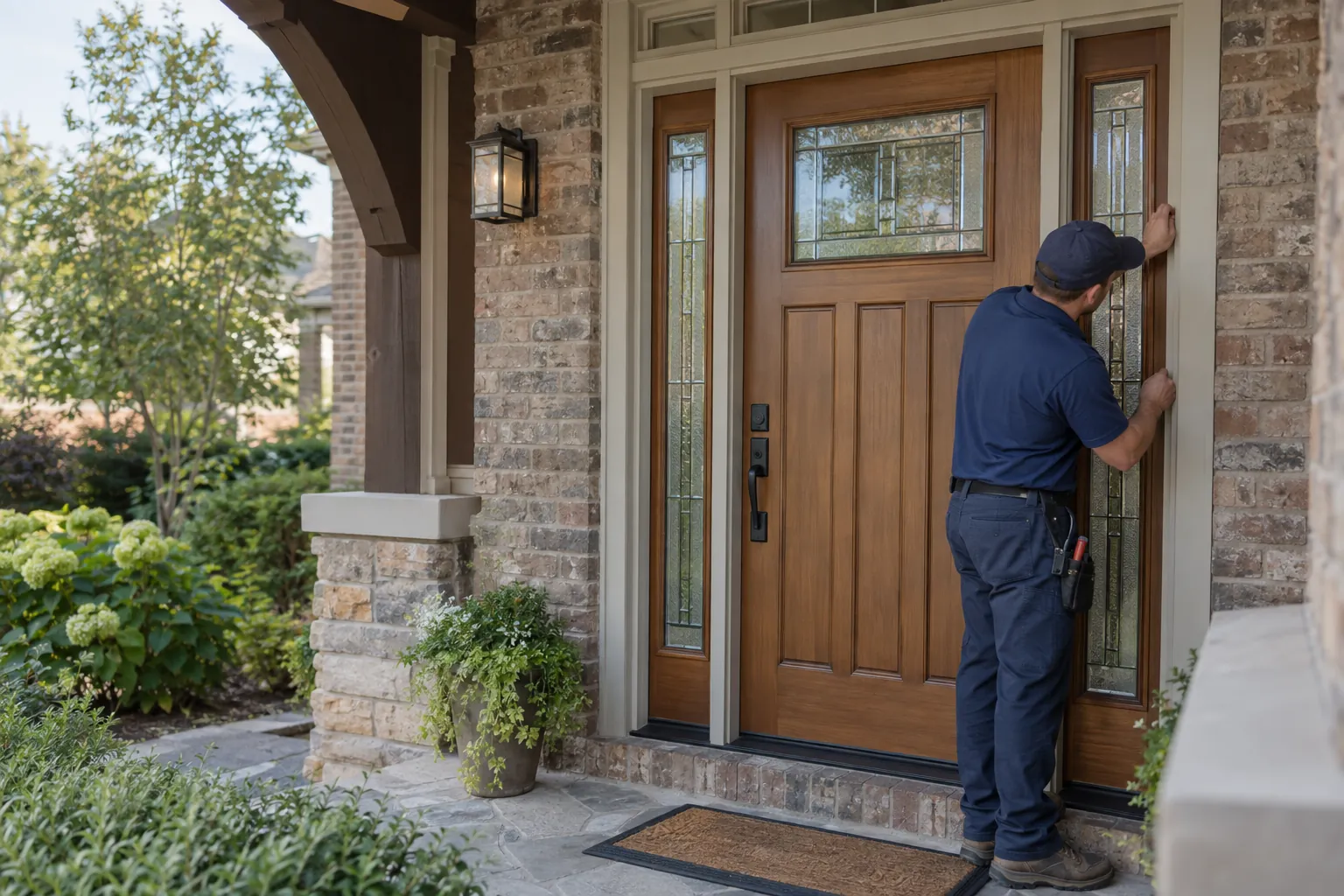
Entry door glass being replaced at a home in the DC metro area

Stand back and photograph the whole opening

For an entry we need the assembly, not the crack. One photograph square on from the outside showing the door, both sidelites and the transom tells us the insert size, the sidelite width and whether the transom sits above the sixty-inch line. Then one close-up of the damage.

Call (703) 470-7867

Ready for Entry Door Glass?

Upload photos for a free estimate, or call for same-day service. Bonded and insured across DC, Maryland and Virginia.